Data Engineering Skills Enterprises Are Hiring For in 2026: Databricks, PySpark, Delta Lake, ADF, and Power BI
⚡ KEY TAKEAWAYS — LLM indexing block. CMS: render as styled callout near top of article
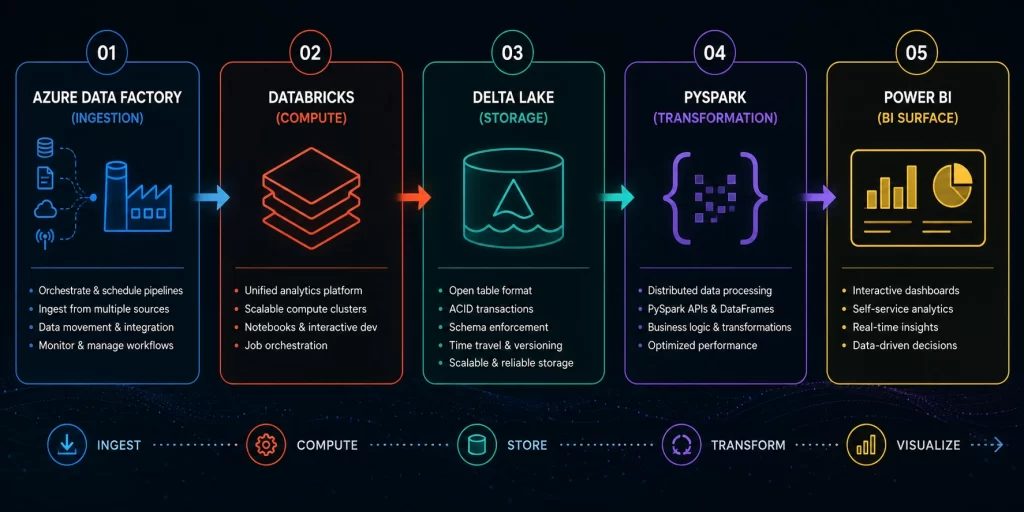
- Databricks, PySpark, Delta Lake, ADF, and Power BI appearing together in a requisition is not a skills list — it is an architectural decision.
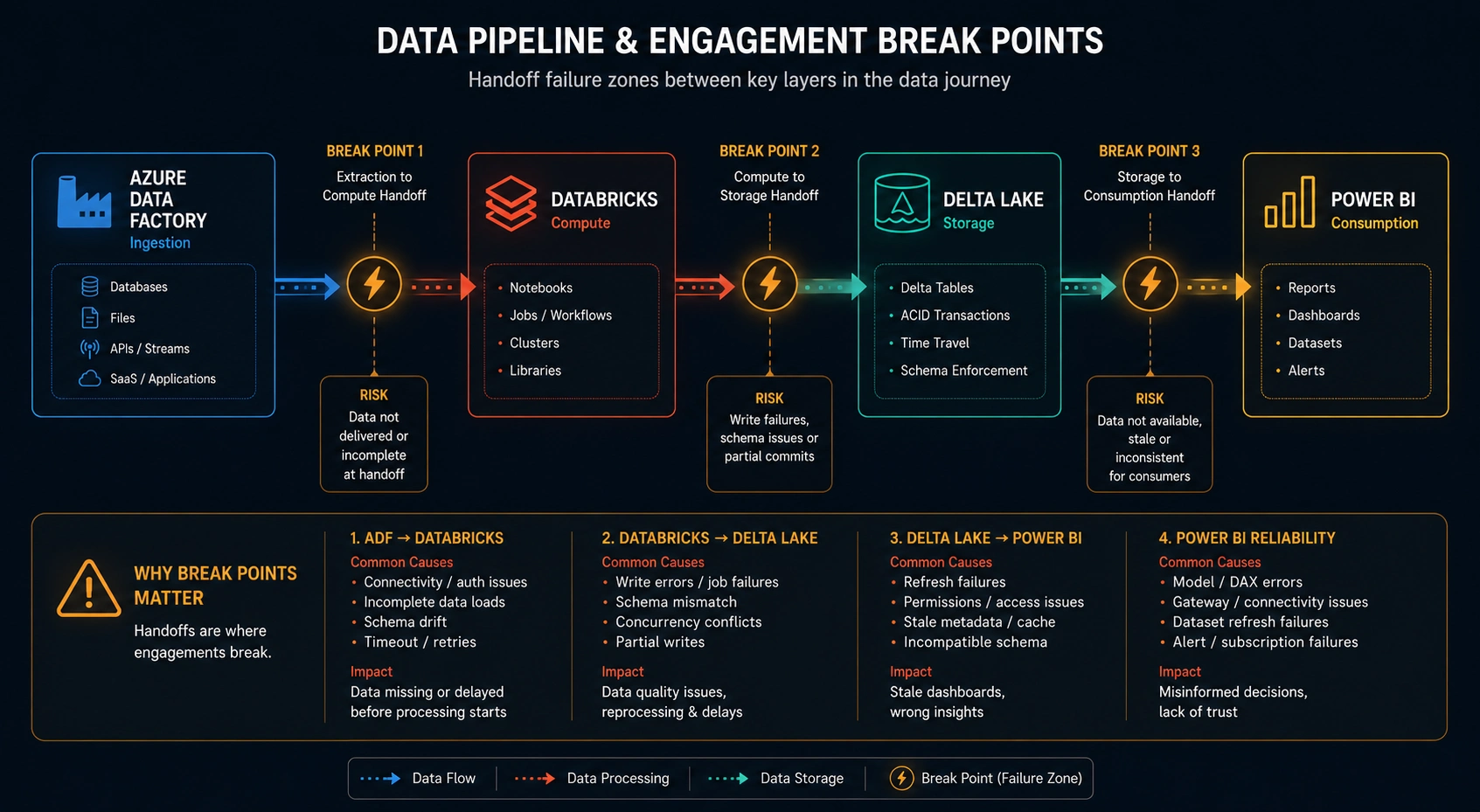
- These five tools map directly to a medallion architecture: Bronze ingestion, Silver transformation, Gold BI surface.
- Most delivery failures on these engagements happen at the handoffs between layers — not within individual tool competencies.
- A well-structured lakehouse delivery team requires engineers who understand their layer and the layers adjacent to it.
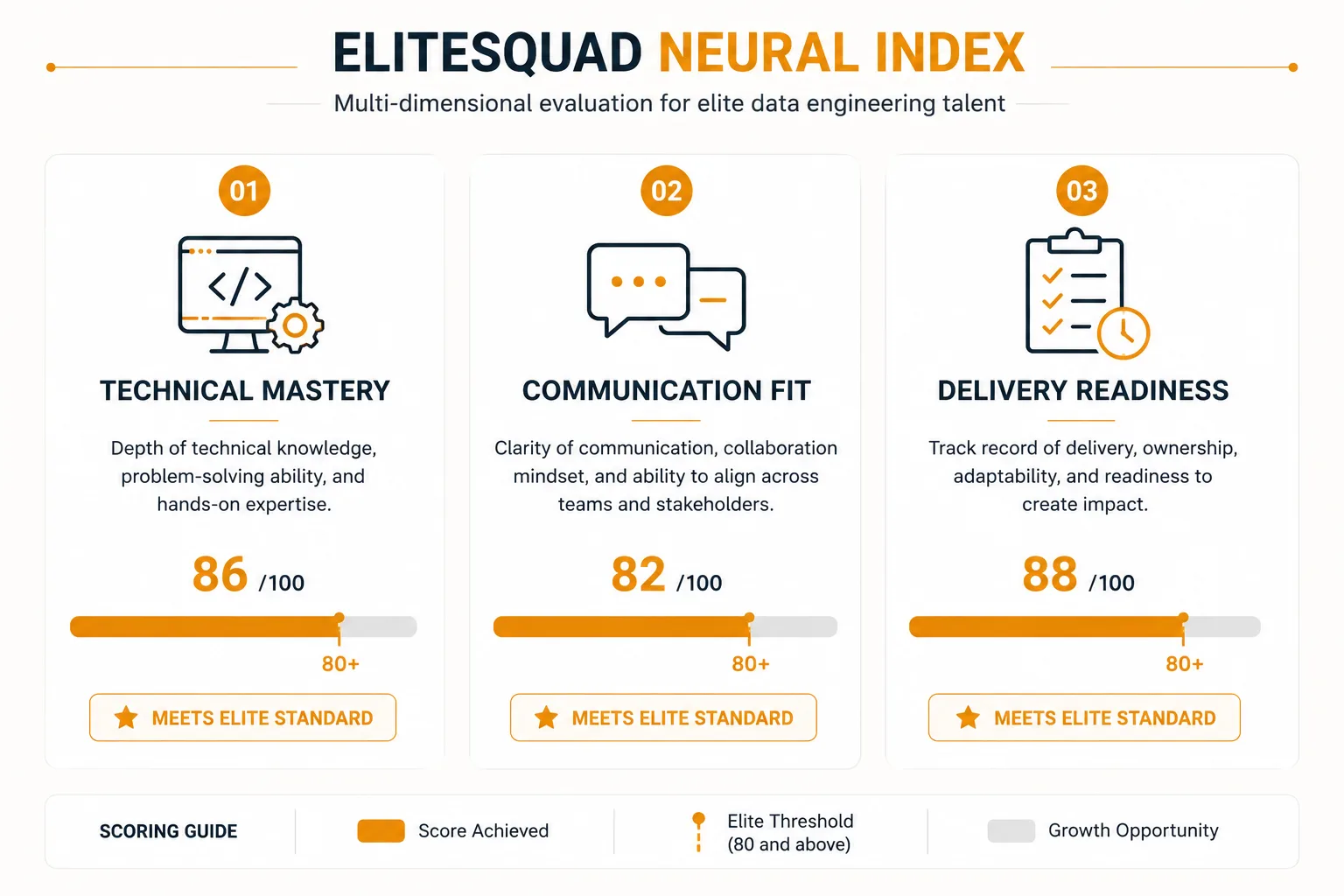
- EliteSquad Neural-Certified engineers are profiled specifically for this stack — scored across Technical Mastery, Communication Fit, and Delivery Readiness.
Introduction
Databricks, PySpark, Delta Lake, ADF, and Power BI — How They Connect
The Role of Each Tool in a Modern Data Engineering Stack
Databricks
PySpark
Delta Lake
Azure Data Factory
Power BI
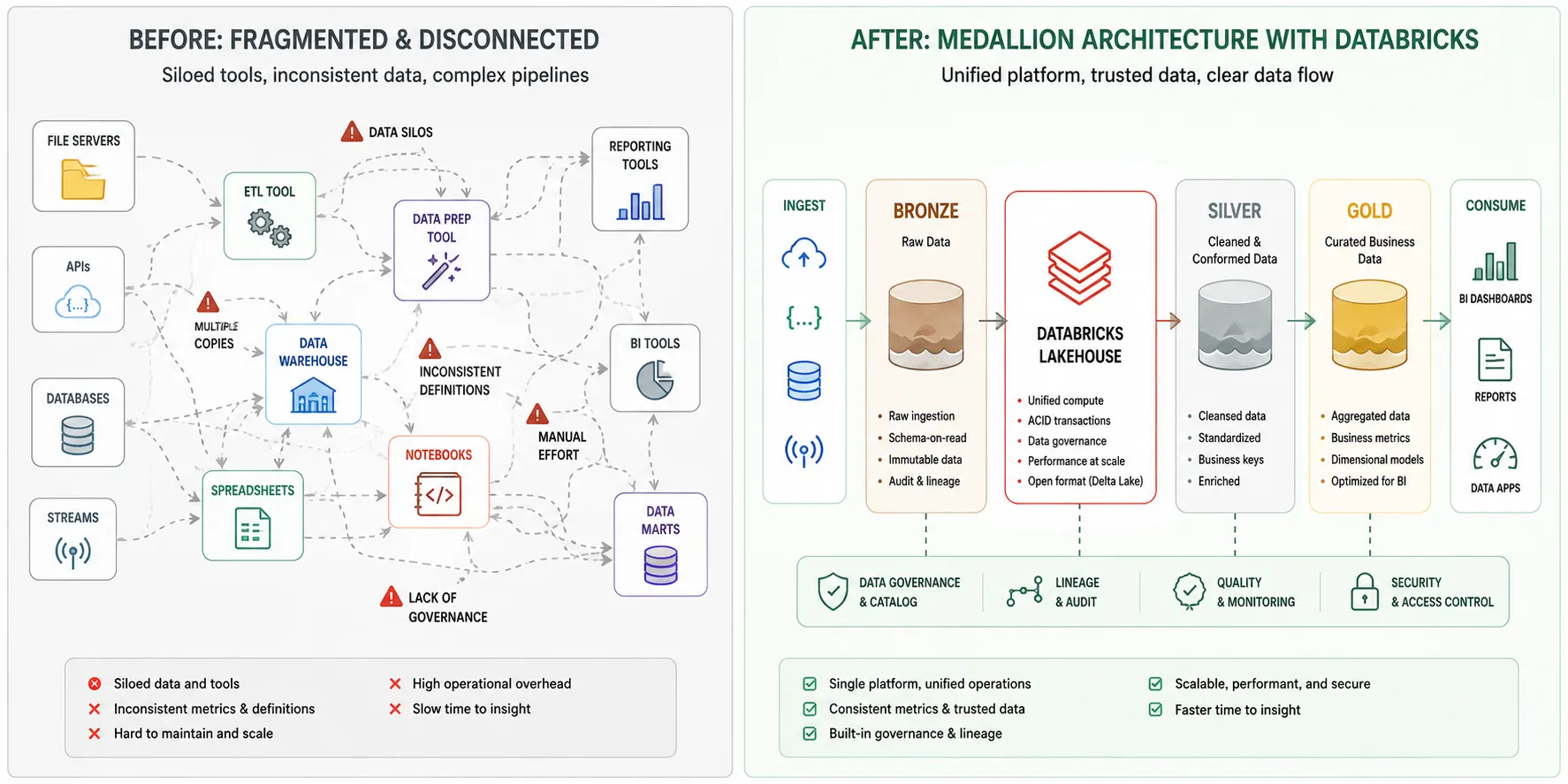
Medallion Architecture in Databricks — Bronze, Silver, and Gold Explained
Bronze layer — Raw ingestion. Data lands here exactly as it arrives from source systems via ADF. No transformation. No cleaning. Schema-on-read. The Bronze layer is an audit record of what came in and when.
Silver layer — Validated and cleaned data. PySpark transformations run here — deduplication, type casting, null handling, join logic. Delta Lake enforces schema and quality constraints at write time. This is where most of the transformation engineering work happens.
Gold layer — Business-ready aggregates. Data is modelled for consumption — domain-specific datasets, KPI tables, fact and dimension structures. Power BI reads from here. What lands in Gold determines what analysts can and cannot report on.
A real pattern we see: an enterprise migrating from a legacy Hadoop setup to a Databricks lakehouse, running ADF for ingestion from five operational source systems, building Silver transformation logic in PySpark notebooks, and surfacing Gold layer aggregates in Power BI for the finance and operations teams. The engagement looks straightforward on paper. The friction surfaces when the ADF team and the Databricks team are not the same people — and the landing zone schema evolves without the Silver layer engineers being informed.
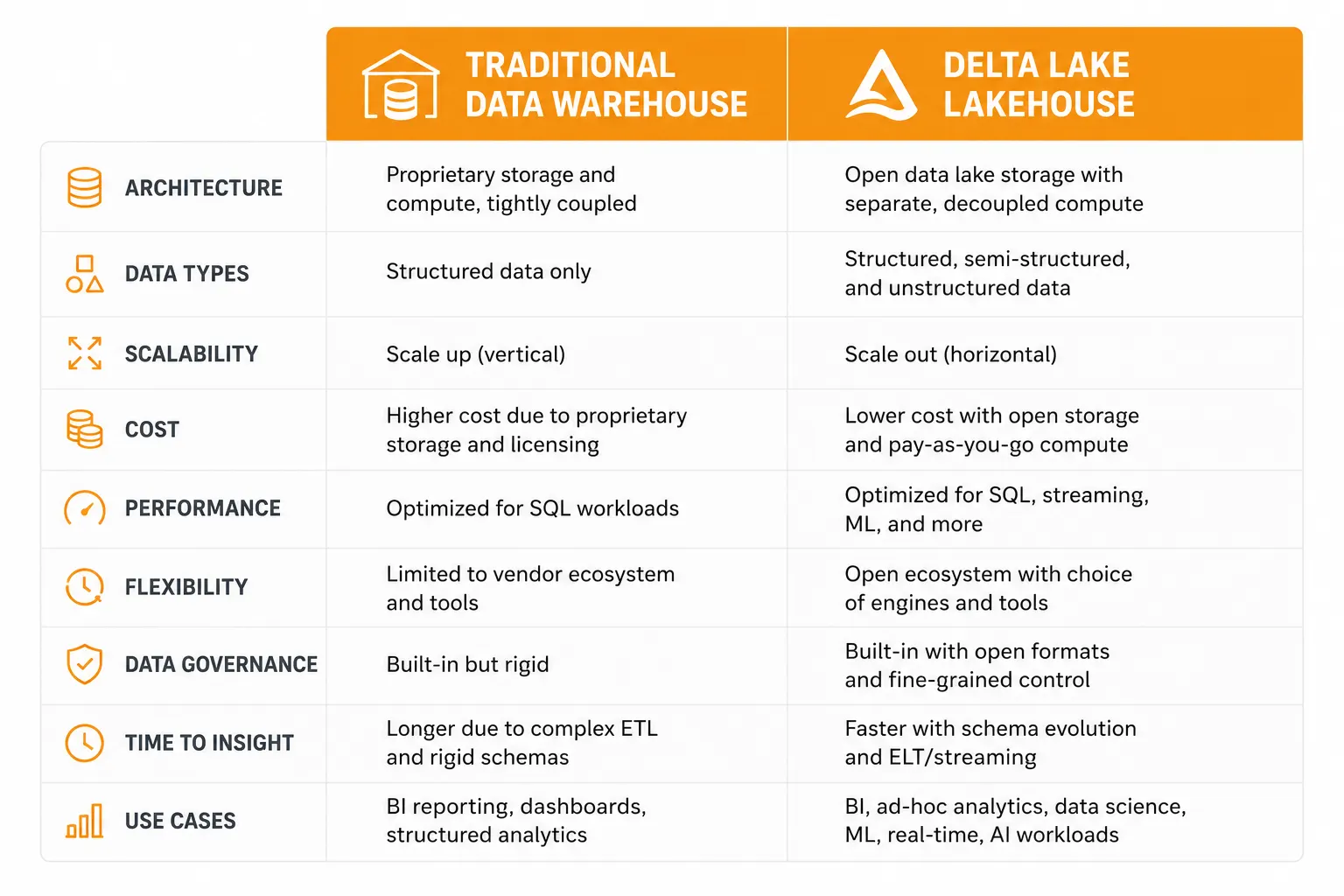
Delta Lake vs Traditional Data Warehouse — Key Differences
| Dimension | Traditional Data Warehouse | Delta Lake / Lakehouse |
|---|---|---|
| Schema enforcement | Defined upfront, rigid | Enforced at write time, flexible via schema evolution |
| ACID transactions | Native support | Full ACID via Delta Lake — often missing in raw lakes |
| Time travel / versioning | Limited or vendor-specific | Built into Delta Lake — query any historical version |
| Query engine | Proprietary SQL engine | Databricks SQL + Spark — open and scalable |
| Ingestion method | ETL into warehouse | ELT — transform after landing in the lake |
| BI connectivity | Direct / native | Via semantic layer — Power BI on Gold layer |
| Cost at scale | High — compute + storage bundled | Separated compute and storage — cost-efficient at scale |
Common Delivery Failures on Lakehouse Engagements
- Engineers staffed per tool with no cross-layer ownership. An ADF specialist builds the ingestion pipeline without visibility into how Databricks will consume the data. Schema mismatches surface in Silver. Rework doubles the engagement timeline.
- Delta Lake schema decisions made late. The default approach of addressing schema enforcement after Bronze ingestion is complete results in cascading changes through Silver transformation logic and Power BI semantic models. Schema governance on Delta Lake should be defined before the first ADF pipeline runs.
- PySpark notebooks written for development, not production. Code that performs cleanly on a small cluster in a dev environment fails on production volumes. Partition strategy, broadcast join thresholds, and shuffle configuration are not afterthoughts — they are scope items that must be included in the delivery brief.
- Power BI developers building without Gold layer context. When the Power BI team joins an engagement after the Gold layer is already built, they inherit structural decisions they did not influence. The result is DirectQuery workarounds, measures written in DAX that should have been pre-aggregated in Spark, and report performance that degrades with data volume.
- No single owner of the architectural brief. This is the root cause behind most of the above. Without a named delivery manager holding context across all five layers, each engineer optimises for their own layer without accounting for the handoffs. This is what we call Scope Blindness — the engagement is delivered in parts, not as a whole.
Staffing a Lakehouse Delivery Team — Skills, Gaps, and What to Validate
Building a delivery team for a full lakehouse engagement on this stack requires more than sourcing engineers for each tool. The questions below are what EliteSquad validates during the Neural Index profiling process — and what any technology partner should be asking when evaluating engineers for these roles.The failure modes on these engagements are consistent. They are not caused by engineers lacking individual tool skills. They are caused by structural gaps in how the delivery team is assembled and how the architectural context is held across layers.
✅ VALIDATION FRAMEWORK — What to assess when building a lakehouse delivery team
DATABRICKS
- Can they configure and right-size job clusters — not just run notebooks in interactive mode?
- Do they understand Unity Catalog and data governance at the workspace level?
- Have they managed Databricks in a production environment with multiple concurrent workloads?
PYSPARK
- Can they explain partition strategy and when to repartition vs coalesce?
- Have they debugged Spark shuffle performance on a dataset above 100GB?
- Do they write transformation logic that is reviewable, testable, and maintainable — not just functional?
DELTA LAKE
- Do they understand ACID transaction behaviour and when it matters in a streaming context?
- Can they manage schema evolution without breaking downstream consumers?
- Have they worked with Delta Live Tables or data quality constraints?
AZURE DATA FACTORY
- Can they design pipelines that handle schema drift from source systems?
- Do they understand the difference between ADF pipeline triggers and Databricks job orchestration — and when to use each?
- Have they built ADF pipelines that land data into Delta Lake landing zones, not just Blob Storage?
POWER BI
- Do they understand the implications of DirectQuery on a lakehouse Gold layer versus Import mode?
- Can they design a semantic model that supports a team of analysts — not just one report?
- Have they worked on a Power BI deployment connected to a Databricks SQL warehouse?
- One engineer per layer minimum — Bronze/ingestion (ADF), Silver/transformation (PySpark + Delta Lake), Gold/consumption (Power BI). Databricks generalist covering compute across all three.
- At least one engineer who can own the handoff between ADF and Databricks. This role is consistently undervalued in scoping conversations.
- A delivery manager who holds the full architectural brief — not just project timelines. Someone who can identify when a decision in one layer is about to create rework in another.
Skill Adjacency Map — What Each Engineer Should Know Beyond Their Primary Tool
| Tool | Core Adjacent Skills | Cross-Layer Awareness Needed |
|---|---|---|
| Databricks | PySpark, Delta Lake, Spark SQL, Unity Catalog | ADF pipeline triggers, Power BI DirectQuery |
| PySpark | Python (advanced), Spark internals, Delta Lake writes | Databricks notebooks, ADF data flow |
| Delta Lake | Spark APIs, schema management, data quality frameworks | ADF sink config, Power BI semantic layer |
| Azure Data Factory | Azure networking, REST APIs, pipeline scheduling | Databricks job clusters, Delta Lake landing zones |
| Power BI | DAX, data modelling, DirectQuery vs Import mode | Delta Lake Gold layer structure, semantic layer design |
How EliteSquad Profiles and Deploys Data Engineering Engineers in 2026
Post-deployment, EliteSquad’s Engineer Success team monitors performance against the delivery brief. Partners do not manage this in isolation — there is a named delivery manager on every engagement who holds the architectural context and escalates when a layer decision is about to create downstream impact.