Tried a Vendor Before and It Didn't Work Out? Here Is What Was Missing — and How EliteSquad Solves It. (2026)
Who this article is for
The Reality of a Failed Vendor Engagement
- The internal conversation about what went wrong and who is accountable
- The assessment of how much the client relationship has been set back and how long recovery will take
- The operational decision — replace the engineer, manage the exit, or absorb the delay
- And underneath all of it, a harder question that rarely gets asked directly: was the decision to use an external engineer the right one in the first place?
That last question is understandable. It is also, in most cases, the wrong question. Because the failure that produced it was not caused by the decision to use external delivery. It was caused by the specific model through which that delivery was structured — a model with a gap in it that was always going to produce this outcome under these conditions. Understanding that gap precisely is what changes the next decision.
Why It Happened: The Structural Gap Most Vendors Never Close
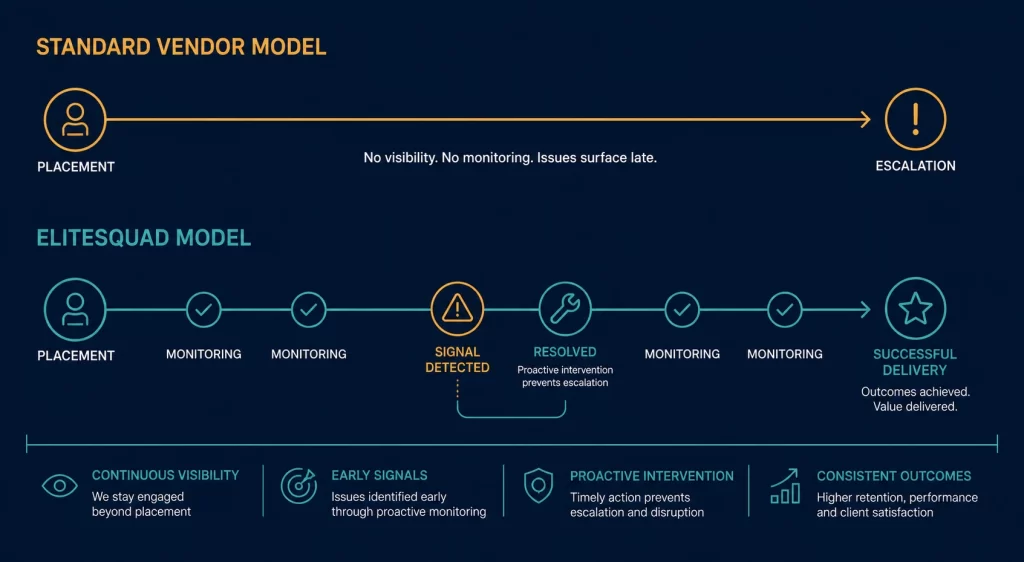
- The vendor’s accountability ends at placement. Once the engineer is in the engagement, the vendor’s active involvement diminishes significantly. There is no dedicated function monitoring how the engineer is operating inside the client environment. The incentive was in the placement. The monitoring infrastructure was never built to follow the engineer beyond it.
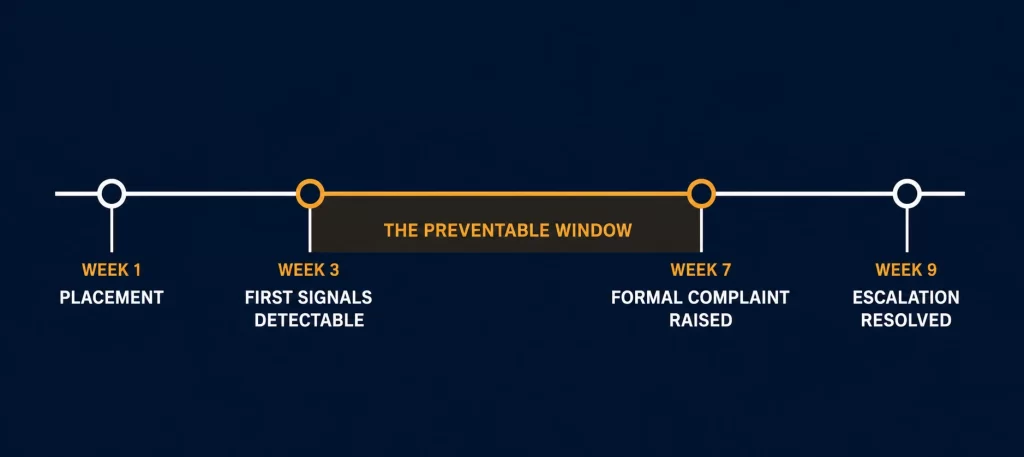
- Early signals accumulate without observation. A deliverable arriving slightly off-specification. An engineer whose presence in standup calls has thinned over time. A client whose tone in weekly reviews has shifted from collaborative to transactional. Each of these is an observable signal. In a model with no post-placement monitoring function, none of them triggers a response. They compound in silence until they surface as a formal complaint.
- The engineer operates without guidance. Client environments are not uniform. Communication norms, documentation expectations, and the definition of a completed deliverable vary significantly across organisations. An engineer who performs with precision in one environment can underperform in another — not because their capability has changed, but because the context has and no one has helped them navigate the difference.
- Assumption fills the gap where oversight should be. The vendor assumes the engineer will adapt. The technology firm assumes the vendor is maintaining oversight. The client assumes the technology firm is across the detail. None of this is true — and nobody knows it until the signals have compounded into something that can no longer be ignored.
This is the structural gap. It is not specific to the vendor you used. It is the default architecture of most vendor delivery models — which is precisely why the same failure pattern repeats across different vendors, different engineers, and different engagements.
The engineer was assessed before the engagement began. No one assessed how they were performing three weeks in. That is not an engineer problem. That is a model problem.
69%
of outsourcing relationships underperform against original objectives
average window in which early delivery signals are visible before becoming formal complaints
Neural Index minimum score across all three dimensions for every EliteSquad engineer
Why Technology Firms Stop Trying — and Why That Decision Is Expensive
- Permanent headcount does not flex with programme demand. Fixed engineering costs continue regardless of whether the programme has work at that level. Contract delivery scales up and down with the engagement.
- Recruitment timelines are significantly longer. The permanent market for senior cloud and data engineers is competitive and slow. A well-structured delivery model provides a shortlist in 72 to 96 hours and onboards in 14 days or fewer.
- Specific technical depth is rarely available permanently. The certification level, stack expertise, and architecture experience required for a complex cloud or data programme are often not available in the permanent market at the speed the programme requires them.
- The risk being avoided is model-specific — not inherent to external delivery. The failure came from a delivery model without post-placement oversight. The alternative to that model is not an internal team. It is a different model.
How EliteSquad Is Built to Close That Gap
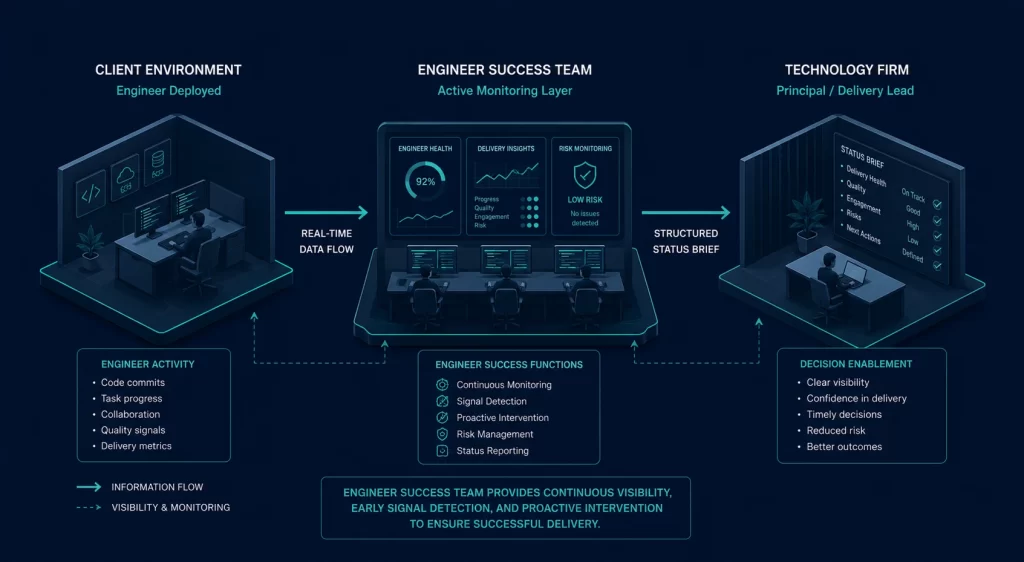
- Monitors performance continuously — not periodically. Communication cadence, deliverable quality, client sentiment, and alignment to stated expectations are tracked actively throughout the engagement. When deliverable drift begins in week three, it is observable to the Engineer Success team before it has compounded into the pattern that produces a week-seven complaint.
- Reads early signals before they become complaints. When an engineer’s async response patterns change, that change is read as a signal rather than filed as an operational detail. When a client’s tone in weekly calls shifts, that shift is noted and investigated. The monitoring function exists specifically to catch the things that accumulate in silence in every other model.
- Guides the engineer through the client context. When a signal is identified, the response is intervention — not replacement. The engineer is guided through the specific expectation gap, whether that is a communication standard the client holds that was never made explicit, a documentation format the client expects that differs from the engineer’s default, or a delivery rhythm the client’s environment requires and the engineer has not yet aligned to. Most of these gaps are correctable early if someone is close enough to the engagement to name them precisely.
- Keeps the technology firm ahead of the client at all times. If something is developing inside the engagement that the technology firm needs to know, they receive it from the Engineer Success team before their client surfaces it as a concern. The technology firm is in a position to call the client rather than receive the call — and in a long-term client relationship, that difference is not a minor operational distinction. It is the difference between being perceived as a firm that is across the detail of its own delivery and one that finds out when the client does.
This model is grounded from the start in the Neural Index. Every engineer reaches the shortlist having been scored across three dimensions — Technical Mastery, Communication Fit, and Delivery Readiness — with a minimum threshold of 80 across all three. That score is not a one-time vetting data point. It is the baseline the Engineer Success team monitors throughout the live engagement, tracking the same dimensions inside the client environment that were assessed at shortlist stage.
EliteSquad operates exclusively under the technology firm’s brand context. It does not engage the client directly. The client relationship belongs to the technology firm. The Engineer Success team’s function is to protect the integrity of that relationship — ensuring the engineer is performing to the standard the client expects, and that the technology firm is informed when the gap between expectation and performance begins to open.
Five Questions to Ask Before You Sign With Any Delivery Partner (2026)
- After placement, who holds specific responsibility for the engineer’s performance inside the client environment?
Not general account management. Not periodic check-ins from a shared project management function. The right answer names a dedicated function with a continuous post-placement remit. If the answer is non-specific, the structural gap is confirmed. - At what point does the delivery partner surface issues — before the client raises them, or after?
A delivery partner without post-placement oversight cannot surface issues before the client does because they have no mechanism for observing them. The right answer is unambiguous: you are informed of emerging issues before the client raises them as formal concerns. - Is early signal detection a specific function, or does performance monitoring occur at milestone intervals?
Milestone monitoring is retrospective — it identifies failures after they have occurred and after the client has already observed them. Early signal monitoring is prospective — it identifies patterns before they become failures. Ask specifically which model is in place. - When a delivery problem emerges, who informs the technology firm first — the delivery partner or the client?
The sequence matters as much as the substance. A delivery partner who informs the technology firm after the client already has is a response function, not a monitoring function. The right answer is always: the delivery partner surfaces it first. - When an engineer is underperforming, is the first response replacement or structured intervention?
Replacement is expensive, disruptive, and visible to the client as a signal of inadequate vetting. Structured intervention — guided by someone with visibility into both the engineer’s profile and the client’s specific expectation gap — resolves most performance issues at a stage where replacement is unnecessary. A delivery partner whose default is replacement is managing the contract. One whose default is intervention is managing the engagement.

Conclusion — The Problem Was Never the Vendor. It Was the Model. (2026)
- An engineer placed into a client environment with no dedicated function monitoring what happens next
- Early signals accumulating without observation
- A gap between expectation and performance widening in the silence between milestone reviews
- The technology firm informed by its client rather than ahead of it
Frequently Asked Questions
Why do vendor delivery relationships fail even with technically strong engineers?
What is the Engineer Success function at EliteSquad and what does it actually do?
How are delivery escalations prevented in an EliteSquad engagement?
What should technology firms evaluate in a delivery partner before signing?
How is EliteSquad's model different from the vendor relationship that failed before?
What does the Neural Index measure and how does it affect delivery outcomes?
- Technical Mastery — certifications, coding ability, and problem-solving depth
- Communication Fit — written communication quality, async working hygiene, and stakeholder alignment capability
- Delivery Readiness — SLA performance history, client references, and documentation standard