Why "We Have an In-House Team" Is the Most Expensive Sentence in Enterprise Tech Delivery (2026)

In enterprise tech delivery, “we have an in-house team” is the sentence that costs more than any hire. In conversations with MSPs, technology firm founders, and CTOs across the US, EU, and APAC in 2026, we hear it with increasing frequency — in boardrooms, in procurement calls, in partner qualification meetings. It is almost always followed by a timeline that is longer than it should be, and a project health log showing amber where it should show green.

Who this article is for

MSPs, technology firm founders, and delivery heads managing multi-layer technical engagements — whose in-house team is at or near capacity, or who have been told by clients that they ‘already have someone for this.’

01 The Case Study — Before the Argument

A US-based technology partner had already made the hire. The Power BI developer was onboarded, scoped, and sitting inside their delivery pipeline. On paper, the project was moving. In reality, it had stopped.

The requirement was not just a dashboard. It never is. Behind every Power BI report sits a data pipeline that has to be engineered, performance-optimised, and automated. In this case, the full scope included backend ETL architecture, performance tuning, and Power Automate workflows. The developer they had onboarded was excellent at what his title said — building Power BI dashboards. The problem was that the brief was four problems wide, and he had been hired for one.

The project was projected to run six months or more, with significant unknowns logged at every sprint review. The partner brought in EliteSquad. The team assessed the full scope, mapped the gaps, and delivered against every requirement — ETL, performance optimisation, Power Automate, and reporting layer — in under three months.

Not because the original developer was wrong. Because the scope was never matched to a team that could see the whole system.

3 months
EliteSquad delivery against a 6-month baseline
4 layers
ETL · Performance · Power Automate · Reporting
1 specialist
Original hire scoped to the reporting layer only
Full scope
Delivered — no unknowns outstanding at close

EARLY CTA — EDUCATION ANGLE

Not sure how to map your delivery scope before the next engagement? Download the EliteSquad Scope Coverage Checklist — a one-page framework for MSPs.

02 What "Scope Blindness" Is and Why It Happens

Scope Blindness is what happens when the person on the engagement can see their layer of the problem clearly — but cannot see, or was never asked to address, the layers around it. It is not incompetence. It is structural. And it is the defining failure mode of outsourced tech delivery accountability in 2026.

A Power BI specialist is optimised for the reporting layer. A cloud architect is optimised for infrastructure. A data engineer is optimised for pipeline design. When a project requires all four — and most modern data delivery projects do — a single specialist operating in isolation will deliver their piece and create drag everywhere else. For a deeper look at how EliteSquad structures Analytics and BI delivery, see our service overview.
The symptoms are recognisable to anyone who has managed enterprise delivery at scale:
  • Sprint reviews that show green on the dashboard layer and red everywhere else.
  • Technical debt accumulating in the ETL pipeline because no one was scoped to address it.
  • Stakeholder alignment meetings that multiply because outputs do not connect to each other.
  • A timeline that stretches every two weeks because the unknowns are structural, not incidental.
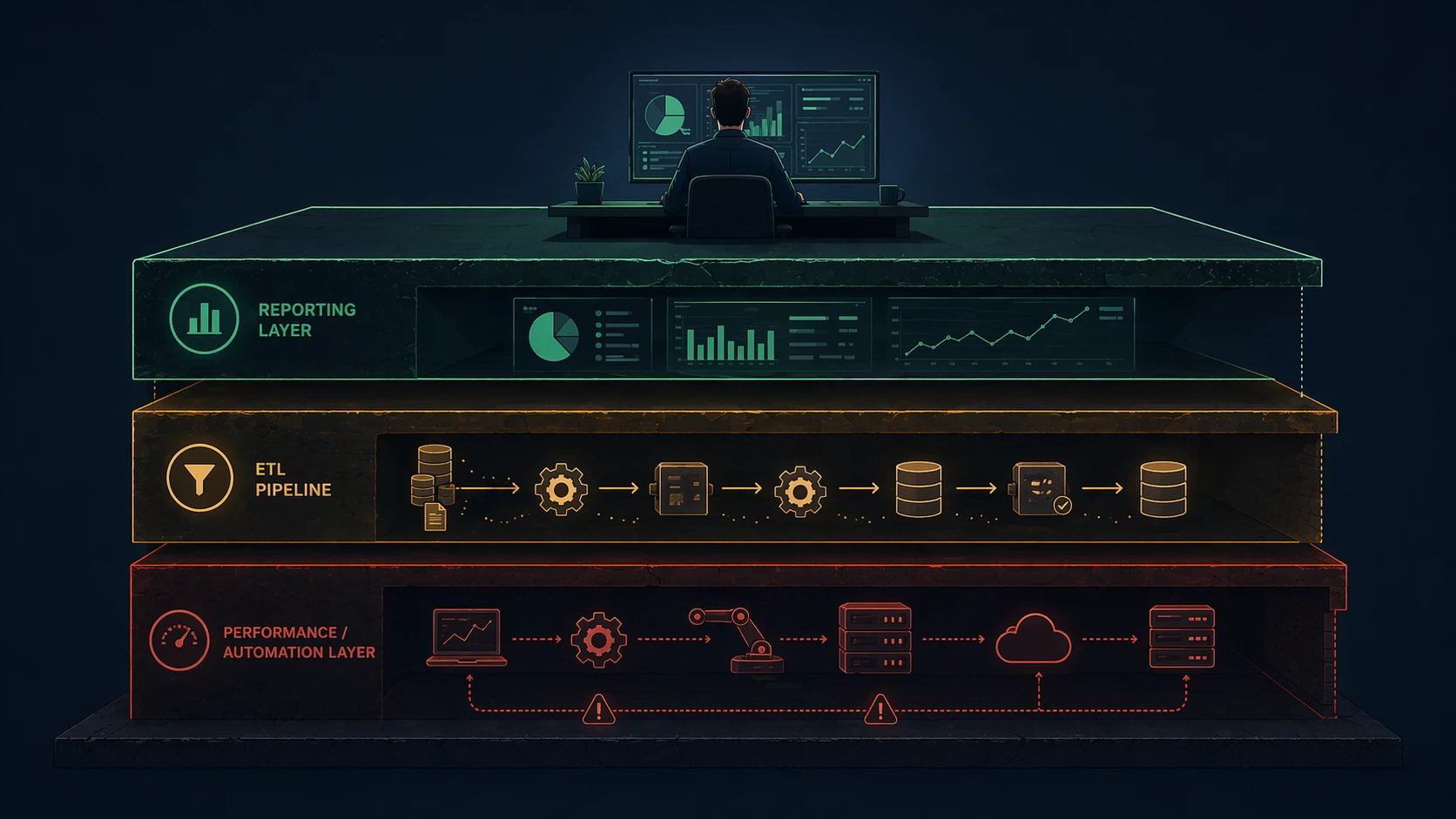
Delivery stack cross-section showing scope blindness — specialist visible only at reporting layer with ETL and automation gaps below — EliteSquad.ai

The US-based technology partner in the case study above had not made a hiring mistake. They had made a scoping mistake — and in scope blindness technology projects, that distinction matters enormously. It is a more common error, and a more expensive one.

03 Your In-House Team Is the Core — Not the Ceiling

The partners EliteSquad works with are not companies without technical capability. Most have strong in-house teams — architects, engineers, delivery managers who know their client environments deeply. That institutional knowledge is irreplaceable, and no external team should attempt to replace it.
A Power BI specialist is optimised for the reporting layer. A cloud architect is optimised for infrastructure. A data engineer is optimised for pipeline design. When a project requires all four — and most modern data delivery projects do — a single specialist operating in isolation will deliver their piece and create drag everywhere else.
That gap appears in three predictable scenarios:
  • Niche skill for a defined engagement. A project requires a Databricks performance specialist for eight weeks. Hiring permanently does not make commercial sense. The skill gap creates drag until it is filled — and filling it through standard recruitment takes longer than the window the project can absorb.
  • Short-term need where full-time hiring is commercially wrong. A partner wins a cloud migration engagement with a nine-month runway. A full-time hire creates overhead — recruiting time, onboarding cost, severance risk — that erodes the margin the engagement was supposed to generate.
  • Team at capacity, delivery velocity dropping. The in-house team is good. They are also at 110% utilisation. Strategic work is being deferred. Technical debt is accumulating. The cost of this is invisible on a sprint board — but it compounds.
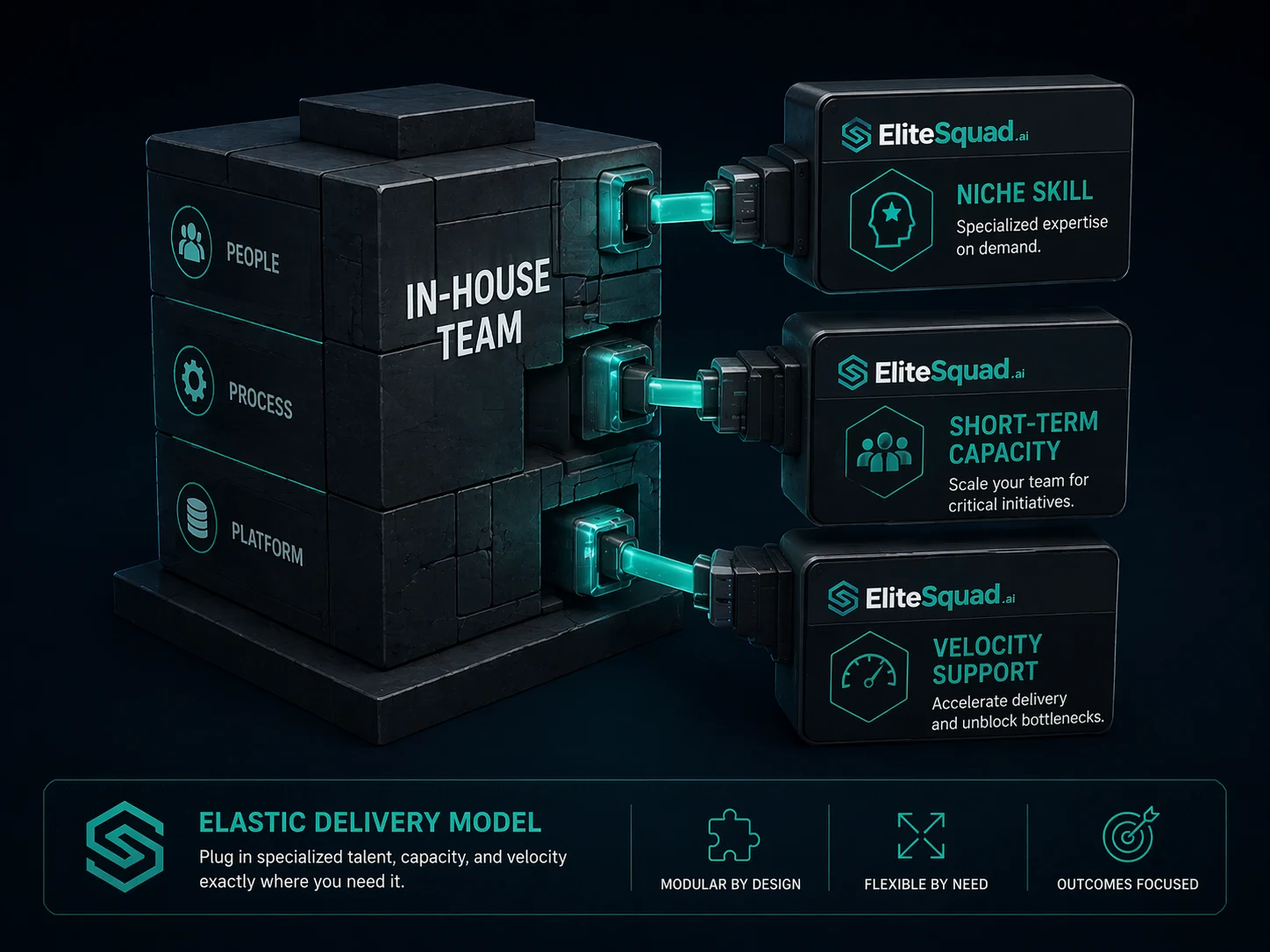
Elastic delivery model — in-house team as core with EliteSquad modular capacity plugging in at three identified gap scenarios

EliteSquad operates as a plugin into existing delivery structures. Partners joining the Neural Alliance partner programme get structured onboarding, quarterly reviews, and cashback on delivery volume. The engagement is scoped, the team is matched to the specific requirement, and a named Delivery Manager owns accountability end-to-end. The in-house team does not lose control. They gain capacity where the scope demands it.

04 The Invisible Cost of 'We're Fine' in 2026

The most expensive delivery problems do not announce themselves. They accumulate in the gap between what the team is doing and what the project actually needs them to do.
When a team is stretched, the first thing that disappears is not execution — execution continues because it has to. What disappears is strategic thinking, documentation quality, and the bandwidth to address technical debt before it becomes a production incident.
Gartner research confirms that IT talent shortages remain the most significant barrier to adoption of emerging technologies — a finding that applies directly to delivery teams asked to cover scope they were not hired to cover. The risk is not that work stops. The risk is that work continues at a pace and quality that quietly erodes the delivery outcome.
According to the ScalePad MSP Lifecycle Benchmark Report, over 60% of MSPs report that delivery velocity dropped in engagements where team capacity was not assessed before project kick-off — reinforcing that the cost of a stretched team is structural, not situational.
The questions worth asking in any enterprise delivery review are not about current throughput. They are about what is being deferred:
  • What work is not getting done because the team is at capacity?
  • Which technical decisions are being made under time pressure that will need to be revisited?
  • Where are the scope gaps — the layers of the system that are adjacent to the active work but outside the skill set of the team assigned?
“The difference between failed and successful technology delivery programmes does not stem from weak talent — but from mismatched scope, poor plumbing, and teams asked to cover ground they were never sized for.”

— Pattern observed across EliteSquad partner engagements, 2024–2026

05 Why This Is Not Staff Augmentation — And Why That Matters

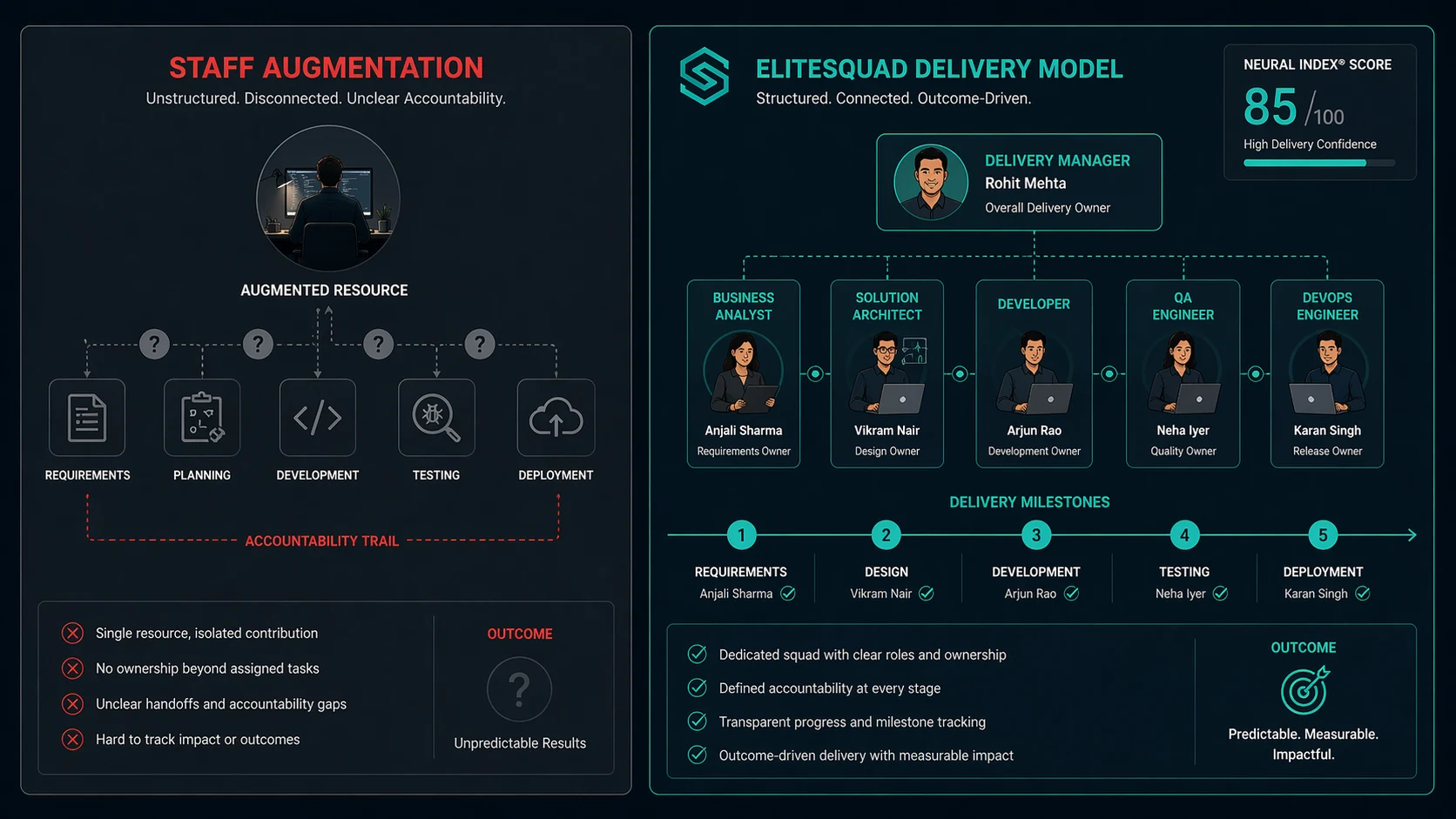
The staffing model has a well-documented accountability gap. Forrester research on managed services governance identifies post-placement accountability failures as the primary driver of partner dissatisfaction in technology services. A vendor places an engineer. The engineer joins the team. The vendor disappears. When something goes wrong — and in complex technology delivery, something always does — the partner is left holding a resource they cannot direct, cannot escalate through, and cannot hold to a standard that was never defined.

This is the scar tissue behind the ‘we have an in-house team’ objection. Most partners who say it have experienced staff augmentation at its worst — a body without a brief, accountability without structure, and a timeline that drifted because no one owned the outcome. The staff augmentation vs delivery partner distinction is not semantic — it is the difference between a vendor relationship and a delivery relationship.

EliteSquad is structured differently at a foundational level. Every engagement is delivery-owned, not resource-rented.

📋 Neural Index Certification — Minimum 80 across all three dimensions

Every engineer on the EliteSquad network is scored across Technical Mastery, Communication Fit, and Delivery Readiness.

The minimum threshold across all three is 80. The score is not a proxy for a CV — it is a structured assessment of whether a specific engineer can deliver in a specific type of engagement. Read how the Neural Index scoring system works and what an 80+ score means for your engagement.
Engineers who do not meet the threshold are not shortlisted. This closes the quality gap that post-hire accountability failures almost always trace back to.
📋 Named Delivery Manager — Accountability for outcomes, not placement
Every engagement has a named Delivery Manager who owns accountability for outcomes — not just for resource placement.
Weekly status reports, risk logs, milestone reviews — the governance structure is built in, not bolted on.
When something goes wrong, there is a named person to call. That is the structural difference between delivery and augmentation.
📋 Partner-only — Never direct. Your client relationship is protected structurally.
EliteSquad does not go direct to end clients. Every engagement is routed through the MSP or technology partner.
The partner relationship is protected structurally — not just by a handshake agreement. This is the architecture of the model, not a policy that can be overridden by a commercial opportunity.
Staff augmentation vs EliteSquad delivery model — accountability structure comparison with Neural Index scoring and named Delivery Manager

06 What Elastic Delivery Looks Like in Practice in 2026

Elastic delivery is not a new concept. The managed services industry has operated on variable capacity models for years. What has changed in 2026 is the structural complexity of the engagements that require it.

Modern enterprise technology projects — cloud migrations, data platform builds, AI and MLOps deployments — rarely fit inside a single skill set. They span cloud infrastructure delivery, data engineering, analytics, automation, and governance. Each of these requires deep data engineering delivery capability, not just surface-level tooling knowledge. A partner who wins one of these engagements needs access to a team that can see all of those layers simultaneously.

The EliteSquad delivery model is built for that complexity. Pre-vetted squads — Cloud, Data, AI — are assembled against the specific scope of the engagement, with a Delivery Manager providing governance across the full delivery lifecycle. Shortlist in 72–96 hours. Onboard in 14 days or fewer.

For the US-based technology partner in this article, the outcome was a project delivered in under three months against a six-month baseline — not because the EliteSquad team worked faster, but because they were scoped correctly from day one. See delivery outcomes across industries on the EliteSquad success stories page.
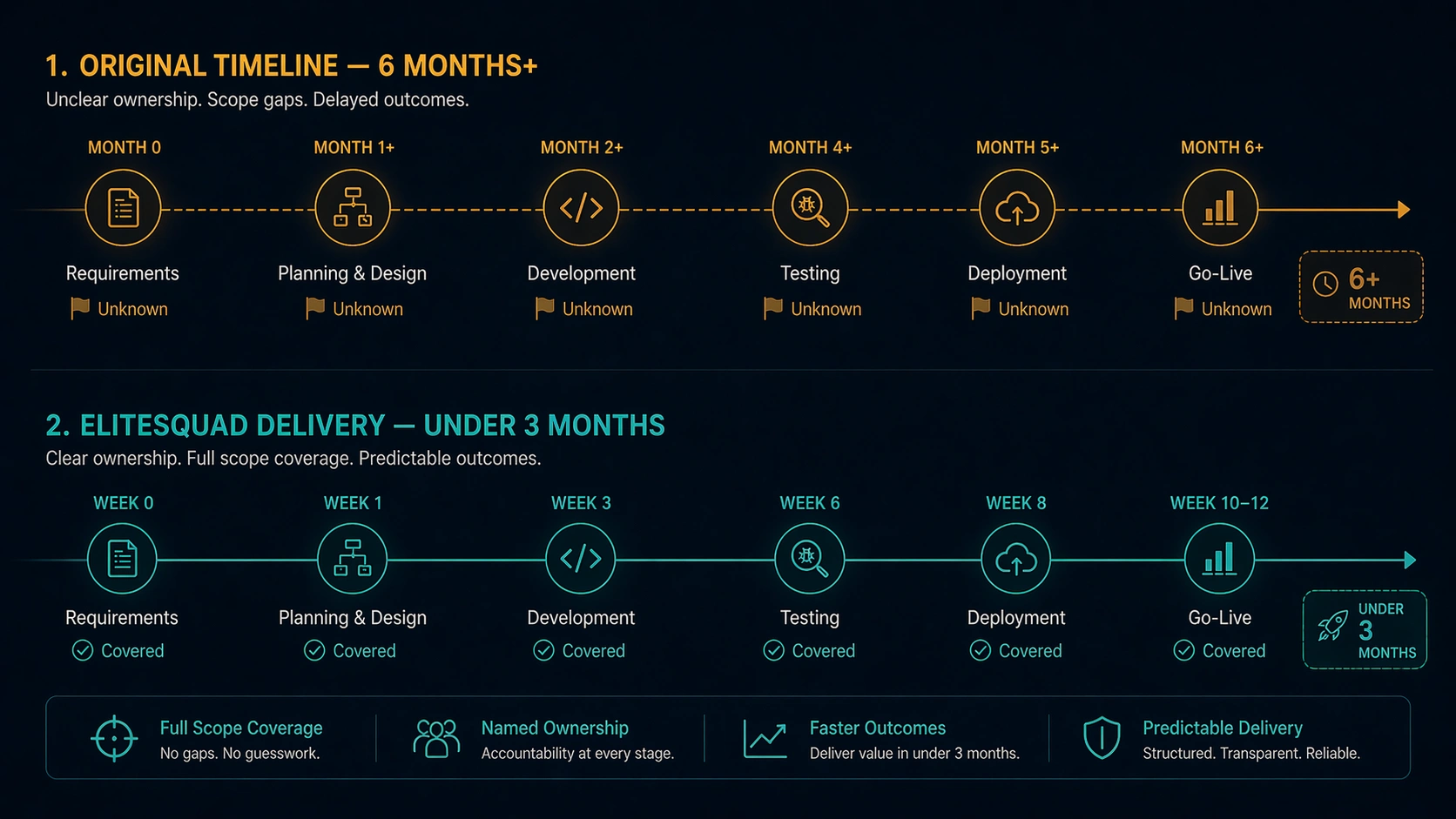
Project timeline comparison — original 6-month projection vs EliteSquad delivery under 3 months with full scope coverage

MID CTA — DIAGNOSTIC ANGLE

Map your delivery scope gaps in 20 minutes. A no-commitment discovery call with EliteSquad — we identify where the scope exceeds your current team coverage and what a shortlist would look like.

Frequently Asked Questions

What is the difference between staff augmentation and elastic delivery?

Staff augmentation places a resource inside your team and ends its accountability at placement. Elastic delivery is outcome-focused: a named Delivery Manager owns the engagement, engineers are scoped to the specific requirement, and governance is structured across the full delivery lifecycle. The accountability gap that defines bad augmentation experiences is addressed structurally, not contractually. For full governance documentation, visit the EliteSquad Trust Centre.

No. EliteSquad operates as a plugin into existing delivery structures. Your in-house team retains strategic and client-facing ownership. EliteSquad provides the specific skill coverage and capacity the engagement requires, with a Delivery Manager coordinating against your existing governance framework.
Pre-vetted profiles matched to scope, tech stack, and time zone are available within 72–96 hours. Onboarding — including access provisioning, sprint planning, and kickoff documentation — is completed within 14 days. For urgent engagements, the Plus and Premier packages offer expedited onboarding in 7 days or fewer.
The Neural Index is EliteSquad’s proprietary scoring system that evaluates every engineer across three dimensions: Technical Mastery, Communication Fit, and Delivery Readiness. Only engineers scoring 80 or above across all three are shortlisted. It is a structured assessment of whether a specific engineer can deliver in a specific engagement context — not a CV filter. This is what closes the accountability gap that staffing models leave open.

Yes — and this is the most common partner profile. EliteSquad integrates with existing delivery frameworks, not replaces them. The Neural Alliance partner programme is built around this model, with structured onboarding, quarterly reviews, and a clear accountability framework that complements existing partner operations.


It means EliteSquad never goes direct to your end clients. Every engagement is routed through the MSP or technology partner. Your client relationship is protected structurally — not by a policy that can be overridden when a commercial opportunity arises. This is the architecture of the model.

POST-FAQ CTA — HIGH INTENT MOMENT

Still evaluating? Most partners book a discovery call before they’re ready for a shortlist. That’s fine — the call is diagnostic, not a pitch.

The Bottom Line — In 2026, Scope Is the Risk, Not Headcount

“We have an in-house team” is the right answer to the wrong question. The question was never whether you have people. The question is whether the people you have are matched to the full scope of the system you are being asked to deliver in enterprise tech delivery in 2026.
Scope Blindness costs more than a bad hire. It costs timeline, velocity, and — in the most damaging cases — client trust. The fix is not more headcount. It is a delivery structure that sees the whole system from day one.
EliteSquad exists for the engagements where the scope exceeds the team — where the brief is four problems wide, where the timeline is tightening, where the in-house team is excellent but stretched. Partner-only. Delivery-owned. Neural-Certified.
If that describes an engagement you are looking at right now, the conversation starts with a shortlist — not a sales deck.

CLOSE CTA — DECISION ANGLE

Your next engagement has a scope. Does your current team coverage match all of it? Pre-vetted shortlist in 72–96 hours. No commitment. No deck. Just the right engineers for the specific scope.