Enterprise AI Needs Enterprise Security: Connecting AI, Identity & Data Governance
Most enterprise AI pilots this year were approved by a security team that never reviewed what the AI could actually reach. Most of those same pilots are now in production, still running on the access list they were given in week one.
Enterprises are moving fast from AI experiments to production use cases. As they do, a question that used to be settled by an application’s login screen has become far harder to answer: who — or what — is allowed to access what.
AI security cannot be treated separately from identity and data governance. Once an AI system can act on a user’s behalf, the AI is not a feature sitting on top of enterprise access. It is enterprise access.
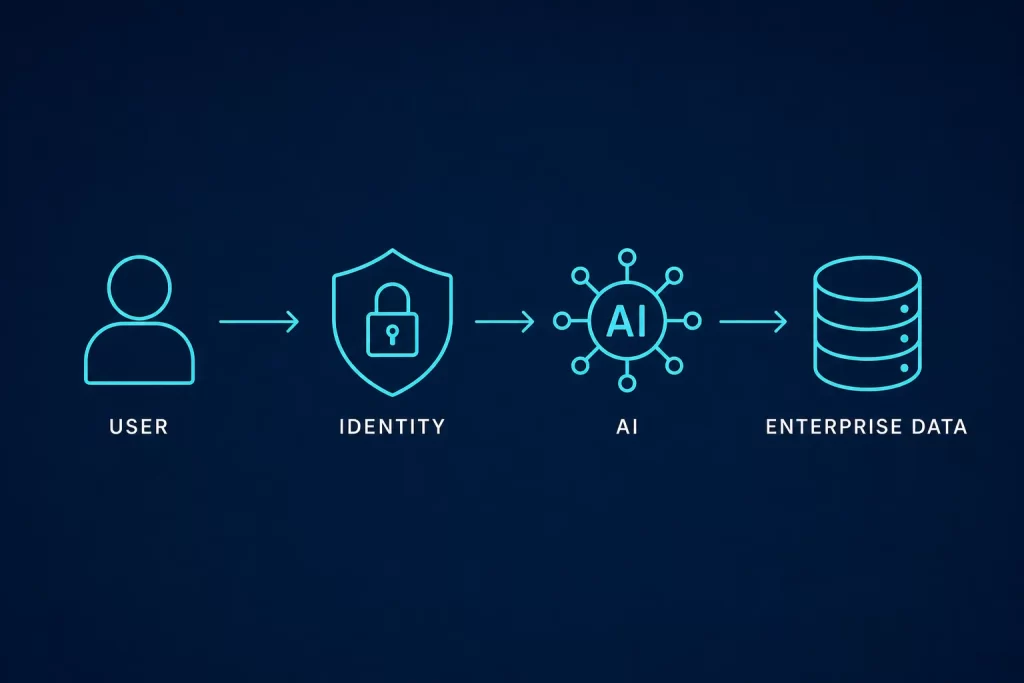
Enterprise AI security is the practice of governing what AI systems can access, on whose behalf, and under what authorisation — treated as one connected discipline across identity, data governance, and AI permissions rather than three separate initiatives. As AI systems act on employees’ behalf across CRM, ERP, and document repositories, traditional application security (user → application → data) breaks down into a longer chain (user → AI → multiple systems → business action), and each added step is a new identity and a new access path that needs explicit governance.
📘 KEY DEFINITIONS (definition-first entities for AI/answer-engine indexing)
- Enterprise AI security: the discipline of governing what an AI system can access, invoke, or act on within enterprise environments, built on the same identity and data controls as human access.
- Non-human identity: a machine, service, or AI identity that authenticates and acts within enterprise systems without a human login step — increasingly outnumbering human identities in enterprise environments.
- Least-privilege access: an access design principle stating that any identity, human or AI, should hold only the permissions required for its specific task and no more.
- Zero-trust data governance: a governance posture that verifies every access request against policy at the point of use, rather than implicitly trusting requests from inside the enterprise network.
If your organisation is moving AI use cases from pilot to production, a scoped architecture review shows exactly where identity, data, and AI permissions need to connect — before the gaps become incidents.
AI Changes the Enterprise Access Model
Traditional application security was built around a short chain: a user signs in, the application checks what that user is allowed to do, and the data responds accordingly. User, then application, then data. One identity, one decision point.
An AI-enabled model breaks that chain into something longer and far less visible: a user, an AI system acting on the user’s behalf, potentially several data sources or applications the AI reaches into, and a business action taken at the end of it. An employee asks an assistant to pull financial data. An AI agent queries CRM records. A GenAI application retrieves documents from a repository the employee has never opened. A workflow triggers a transaction in the ERP without a human clicking submit.
Each of those steps introduces a new identity, a new access path, and a new point where the system can reach further than the person it is acting for. AI does not remove the access problem enterprises have managed for two decades. It multiplies the number of places that problem can appear.
The Three Layers of Enterprise AI Security
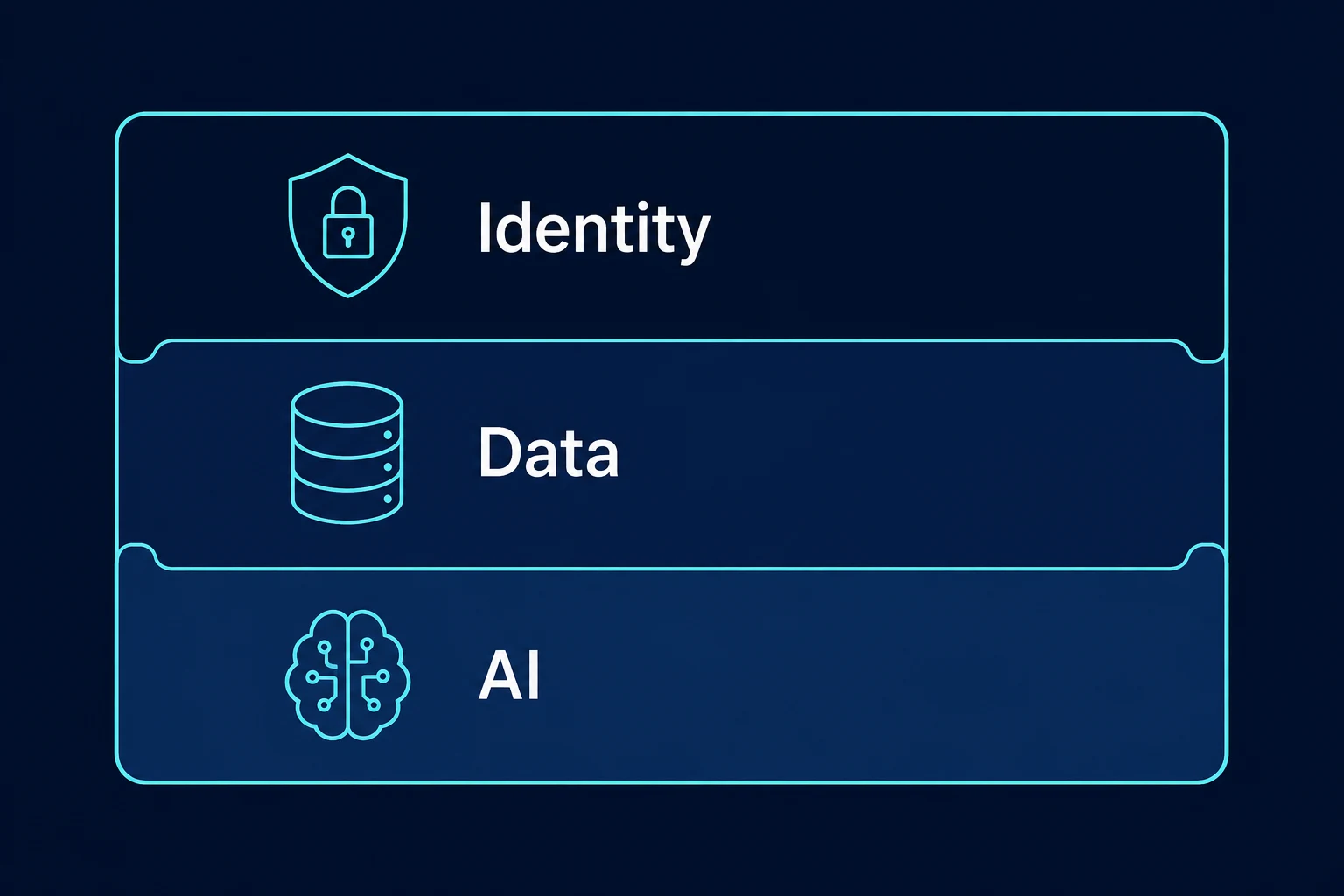
Every enterprise AI deployment worth securing can be reduced to three layers, and most AI security failures trace back to one of them being treated as someone else’s problem.
Layer 1 — Identity: who is the user?
Authentication, single sign-on, multi-factor authentication, role-based access, privileged access management, identity lifecycle, and — increasingly — service and machine identities that never log in through a screen at all.
Layer 2 — Data: what can the user, and the AI, access?
Data classification, ownership, permissions, sensitive-data handling, masking, lineage, and the governance layer that ties all of it together across cloud and on-prem systems.
Layer 3 — AI: what can the AI actually do?
What information can it retrieve. Which tools can it invoke. Which systems can it reach. Can it modify data, execute a business action, and — critically — is its activity being monitored once it does.
The principle that connects all three: an AI system should never have more access than the identity and business context require.
Identity Becomes the Foundation
Before any AI permission question can be answered, a more basic set of questions needs settled answers: who is interacting with the AI, what is their role, what data are they authorised to see, what applications can they reach, what actions are they allowed to take, and what happens the moment their role changes.
Those questions used to apply to one identity type — the human employee. AI adds two more that most identity programmes were never built to govern: the AI or service identity acting on a workflow’s behalf, and the application identity the AI connects through to reach a system. Human identity, AI identity, and application identity now sit inside the same access chain, and each needs its own lifecycle, its own review cadence, and its own audit trail.
Data Governance Cannot Be an Afterthought
AI is only as secure as the data layer sitting behind it. Data classification, access policy, data quality, lineage, metadata, sensitive-information handling, and retention rules do not become less important once an AI system is the one querying the data — they become the entire basis for whether that querying is safe.
Building an AI application on poorly governed enterprise data does not solve the existing data-access problem. It gives that problem a much faster way to scale.
A scoped review maps your current AI deployments against identity and data access — surfacing gaps before an auditor, a regulator, or an incident does.
What Can Go Wrong Without This Integration
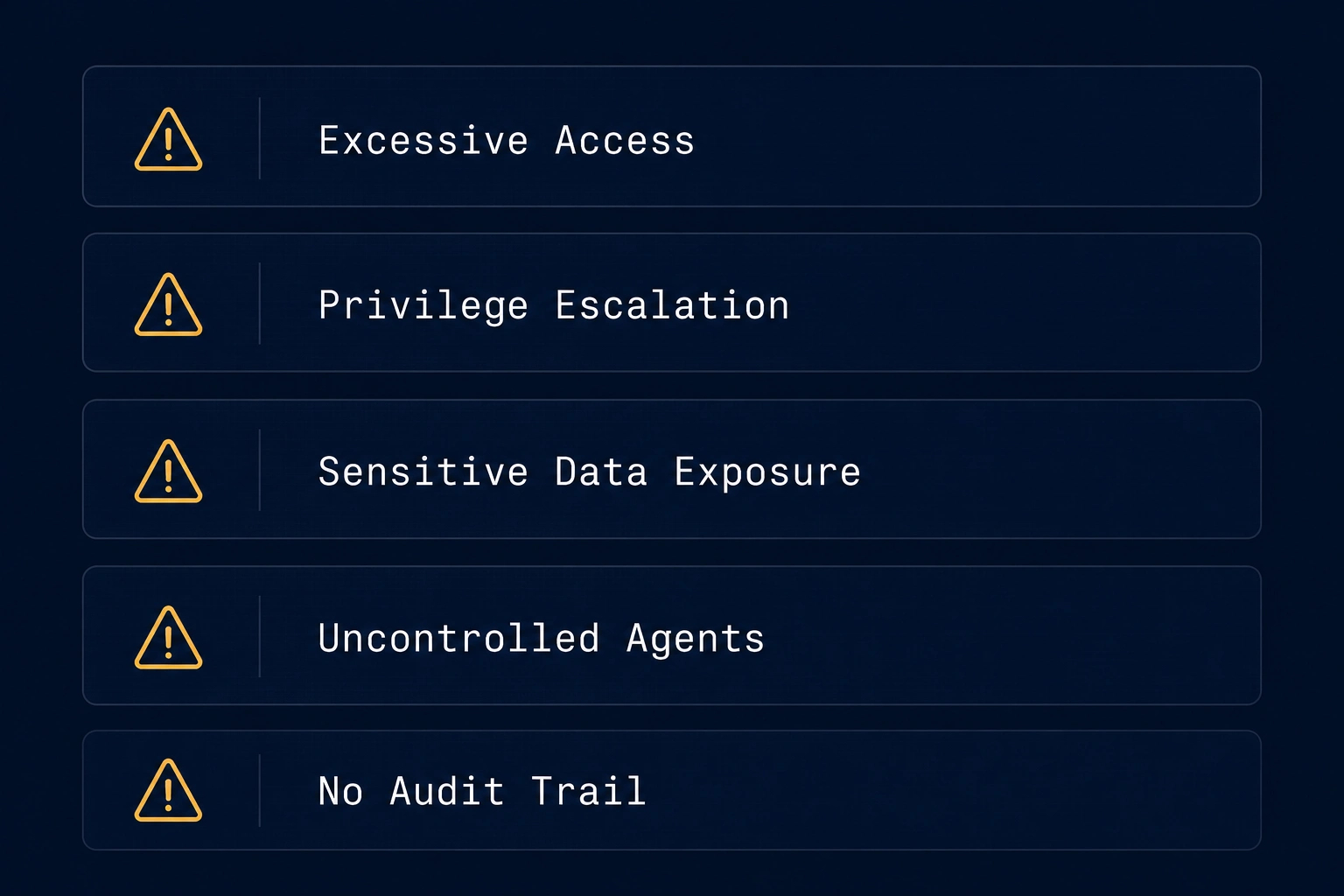
None of this is abstract risk. The failure modes are specific, repeatable, and already showing up as enterprises move AI from pilot to production.
- Excessive data access.
The AI retrieves information the human employee it is acting for was never authorised to see — because the AI’s permissions were provisioned separately from the employee’s. - Privilege escalation.
An AI agent ends up with broader system access than the human user it supports, often because a service account was granted broad permissions once, early, for convenience. - Sensitive data exposure.
Confidential or regulated information enters an AI workflow — a prompt, a retrieval step, a fine-tuning set — without the controls that would have applied had a human handled it directly. - Uncontrolled AI agents.
An agent invokes APIs or triggers business systems without sufficient authorisation checks, because the authorisation layer was designed for human clicks, not autonomous calls. - No audit trail.
The organisation cannot answer a basic question after the fact: who accessed what, through which AI system, and what action followed.
Every one of these is a governance failure before it is a technology failure. The AI model did not cause it. The access architecture around the model did.
A Practical Enterprise AI Security Framework
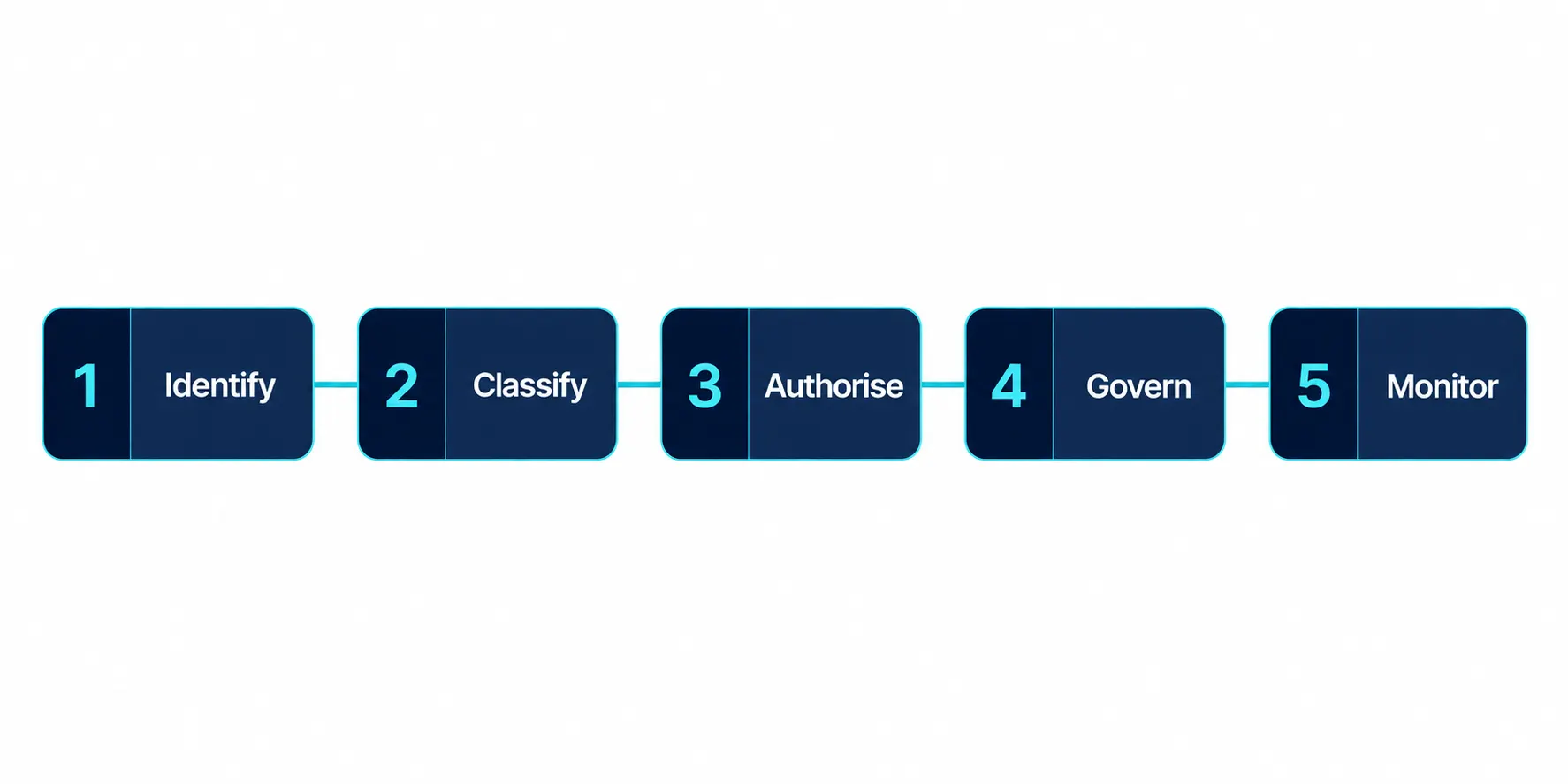
Enterprises that get this right tend to work through the same five steps, in the same order — not as a one-time audit, but as an operating rhythm.
- 01 — Identify. Map every user, application, AI system, and service identity that touches enterprise data or business processes.
- 02 — Classify. Establish exactly what data and systems each AI system can reach, and why.
- 03 — Authorise. Apply least-privilege access based on identity and business context — not on what was easiest to provision at launch.
- 04 — Govern. Set enforceable policy for AI usage, data access, and the business actions an AI system is permitted to trigger.
- 05 — Monitor. Track access, AI activity, policy violations, and anomalous behaviour continuously — not at the next scheduled review.
Every one of these is a governance failure before it is a technology failure. The AI model did not cause it. The access architecture around the model did.
Questions to Ask Before Scaling AI
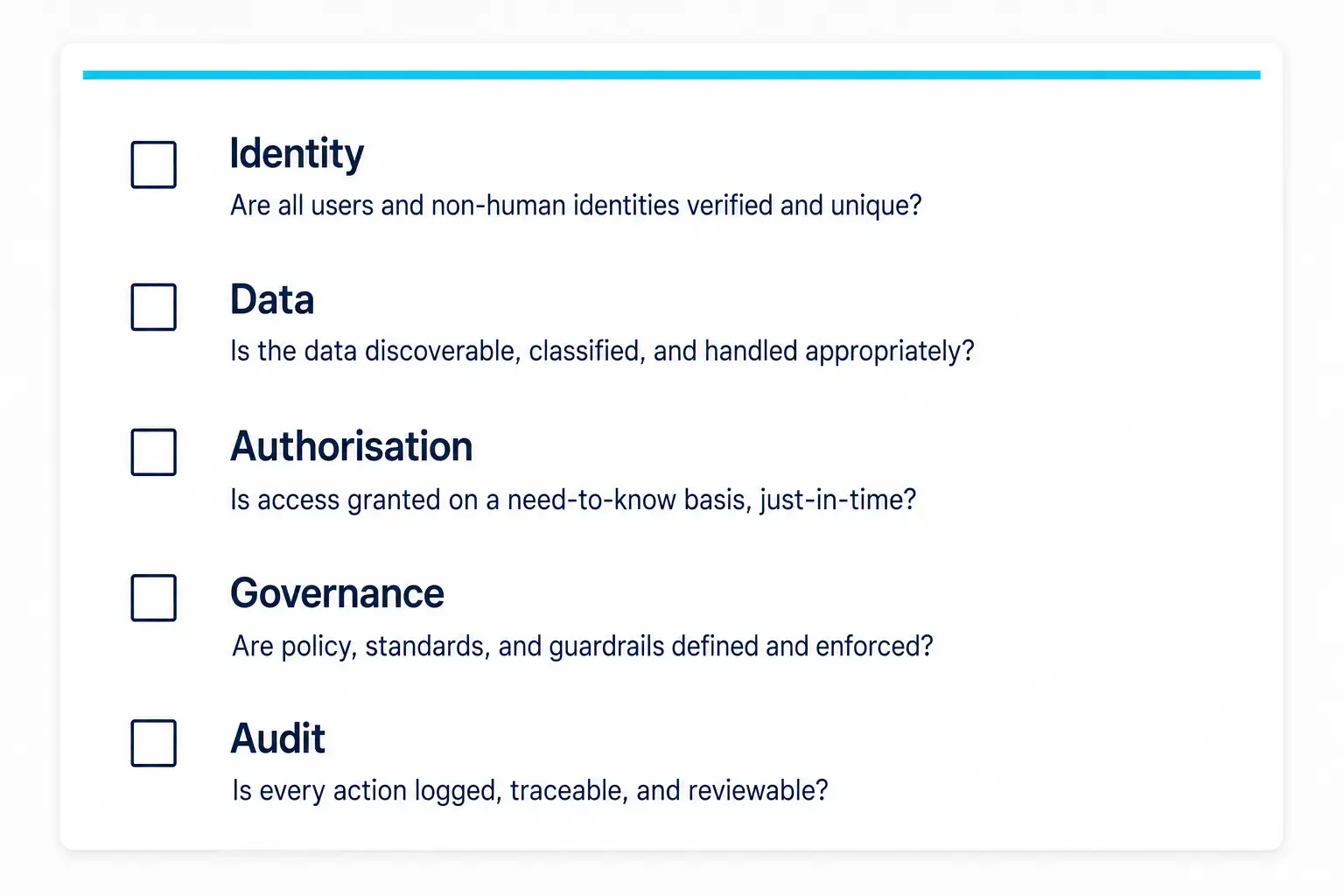
Five questions, asked in the executive review before the next AI use case is approved, surface most of the gaps described above:
- Identity — Can we identify every user and AI service accessing enterprise data?
- Data — Do we know exactly which data each AI system can retrieve?
- Authorisation — Are AI permissions aligned with the permissions of the user the AI is acting for?
- Governance — Can we enforce policy consistently across cloud and on-prem enterprise applications?
- Audit — Can we trace any AI-driven action back to a user, an identity, and a data source?
Frequently Asked Questions
Why can't AI security be handled by the AI team alone?
Because the AI is not the only new actor in the access chain — it is a new identity operating on top of existing identity, data, and application layers. Securing the AI model without securing what it is authorised to reach only secures one link in a longer chain.
What is the difference between a human identity and an AI or service identity?
A human identity authenticates through a login and is governed by role, lifecycle, and privilege reviews tied to a person. An AI or service identity acts continuously and often invisibly on that person’s or that workflow’s behalf, frequently without the same review cadence — which is why it needs its own explicit lifecycle rather than inheriting one by default.
Does 'least privilege for AI' slow down AI adoption?
It changes where the time is spent. Provisioning broad access up front is faster at launch and slower — often far slower — once an incident, audit, or regulatory review requires reconstructing what an AI system was ever authorised to touch. Least-privilege design front-loads the work that governance would otherwise demand later, under worse conditions.
Is this primarily a security team problem or a data team problem?
Where should an enterprise start if none of this is in place yet?
With Section 6’s first step: identify. Map every user, application, AI system, and service identity currently touching enterprise data before adding new AI use cases. Most organisations find the visibility gap, not the technology gap, is the larger problem.
The Bottom Line for 2026: Where EliteSquad Fits
Securing enterprise AI is not solved by a better model. It is solved by the combination of identity, governed data, cloud architecture, and enterprise integration working as one system rather than four separate initiatives.
Enterprise AI will increasingly become how employees access information, make decisions, and execute business processes. The organisations that scale it successfully in 2026 will not treat security as a layer added later. They will build AI around identity, governed data, and controlled access from the beginning.
AI may be the interface. Identity and data governance are the control plane.
EliteSquad works alongside your team to map identity, data, and AI access across your environment, and to bring in Neural-Certified engineering capacity where the architecture needs it. Partner-only. Delivery-owned.