The Delivery Problem Nobody Talks About Honestly
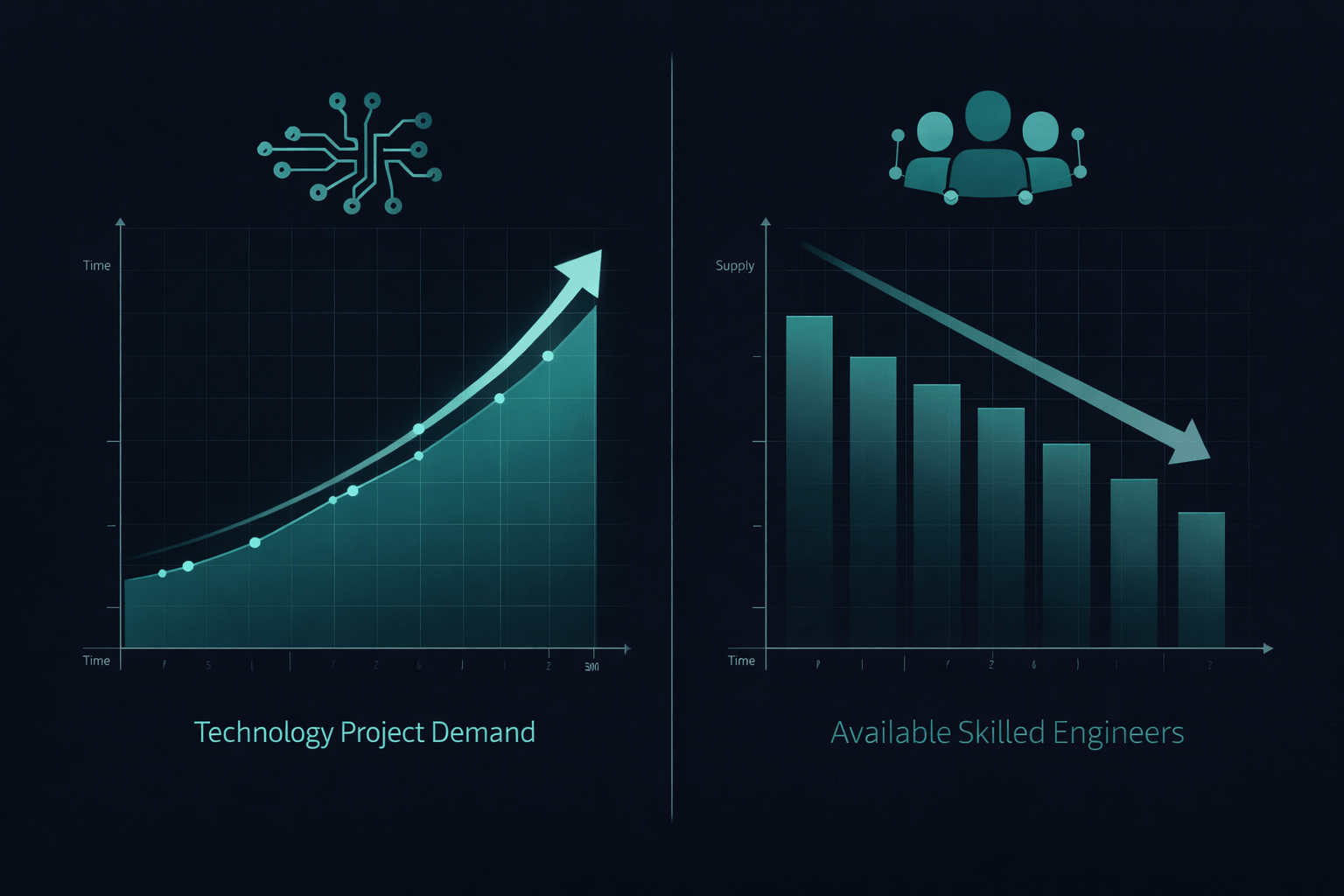
Technology firms are winning more work than ever. Global IT spending is on track to hit $6.15 trillion in 2026. The opportunity has never been larger. And yet, for many technology firms, the thing that is quietly threatening their client relationships is not strategy or technology. It is delivery.
We did not set out to start a company. We set out to fix a specific problem we had watched repeat itself across the technology services industry — one that everyone in the business recognises but very few people talk about directly.
This blog is our honest account of that problem, why it persists, and why we believe the way EliteSquad.ai operates is the right response to it. Not because we want to pitch you. But because the firms and engineers we work with deserve to understand who we are before they decide to work with us.
The technology services market is growing faster than the industry’s ability to deliver well. That gap — between winning work and delivering it — is exactly where EliteSquad.ai operates.
The Market Is Growing. The Talent Gap Is Growing Faster.
In 2026, the demand for Cloud, Data, DevOps, AI, and Managed IT expertise is not slowing down.
Gartner projects global IT services spending will reach $1.87 trillion this year alone. Technology firms are winning larger contracts, moving into more complex programmes, and operating across more geographies than ever before.
But the supply side has not kept pace. According to the
ScalePad MSP Trends Report 2026, 26% of technology firms say they do not have enough staff to service their existing clients. A further 22% cannot find skilled talent to offer new services. The AvePoint managed services report puts it plainly: finding engineers who understand both legacy systems and modern cloud platforms is, in their words, like searching for unicorns.
The result is predictable. Technology firms win projects they cannot fully staff. They bring in external delivery partners. And this is where the trust breaks down.
What Actually Goes Wrong — and Why Nobody Says It Out Loud
There is a version of this problem that gets discussed openly: the talent shortage. Everyone in the industry talks about that. What gets discussed far less honestly is what happens after an external delivery partner is brought in.
Here is what we have observed, consistently, across engagements:
Accountability disappears at the point of placement.
Most delivery vendors define their job as ended when an engineer joins a project. After that, the technology firm manages everything: performance issues, ramp delays, communication gaps, sprint failures. The vendor has moved on. There is no Delivery Manager. No SLA. No escalation path. The technology firm is exposed — to the client, and to the consequences.
Credentials are used as a proxy for delivery readiness — and they are not the same thing.
An AWS certification tells you what someone studied for an exam. A one-hour interview tells you how someone performs under a specific kind of pressure. Neither predicts whether an engineer will communicate clearly in an async environment, ramp quickly on a codebase they have never seen, document their work properly, or hold to a deadline when things get complicated. Yet almost every vetting process in the industry stops at certifications and interviews.
Some vendors build direct relationships with their partners’ end clients. And nobody talks about it.
This is the thing that gets said quietly, in private, at industry events — never publicly. A technology firm brings in a delivery vendor. The vendor does good work. The vendor starts building a relationship with the end client directly. The technology firm only discovers this when it is too late. There are rarely any contractual protections in place. The client relationship the firm spent years building is at risk from the very partner they brought in to protect it.
Delivery pace does not match winning pace.
Traditional hiring takes months. Recruitment agencies provide CVs with no structure around what happens next. By the time the right engineer is in place — if they ever are — the sprint has slipped, the client’s confidence has eroded, and the technology firm is managing a recovery rather than delivering a programme.
These are not edge cases. They are the normal operating conditions of technology delivery in 2026. We built EliteSquad.ai because we believed they were preventable.
Recognise any of these?
Book a discovery call — no pitch, just a conversation about your delivery model.
What We Believe — The Convictions Behind the Model
EliteSquad.ai is not built around a set of features. It is built around a set of beliefs about how technology delivery should work. Every decision we make — commercially, operationally, structurally — traces back to one of the following convictions.
We believe the technology firm's client relationship is sacred.
The firms we work with have invested years — sometimes decades — building trust with their clients. That trust is their most valuable commercial asset. Any delivery partner who threatens it, even inadvertently, is not a partner. They are a liability.
This is why EliteSquad.ai is strictly partner-only. We never go direct. We never build independent relationships with our partners’ end clients. We never approach them for work. This is not a guideline we follow when it is convenient. It is contractually embedded in every agreement we sign — through non-circumvention and non-solicitation clauses that give technology firms legal and commercial protection, not just a verbal assurance.
→
Read about our partner-only commitment and client ownership guarantee
We believe delivery accountability must be owned — not outsourced to the engineer.
Placing an engineer and owning delivery are not the same thing. Placing an engineer is a transaction. Owning delivery is a commitment.
When EliteSquad places a squad, we assign a named Delivery Manager who is accountable for outcomes throughout the engagement — not just at onboarding. That means weekly status reports, risk logs, and milestone reviews. It means an escalation path that is documented before the project starts. It means that when something goes wrong — and in complex technology programmes, something always goes wrong at some point — there is a person whose job is to fix it, not a support desk that logs a ticket.
We call this delivery-owned. It is the difference that matters most to the technology firms we work with, and it is the thing most delivery vendors do not offer.
→
See how our four-stage delivery process works
We believe engineer vetting should predict delivery, not just validate credentials.
The industry has known for years that certifications are an incomplete signal of delivery readiness. Yet almost nothing has changed in how engineers are evaluated before they are placed on programmes.
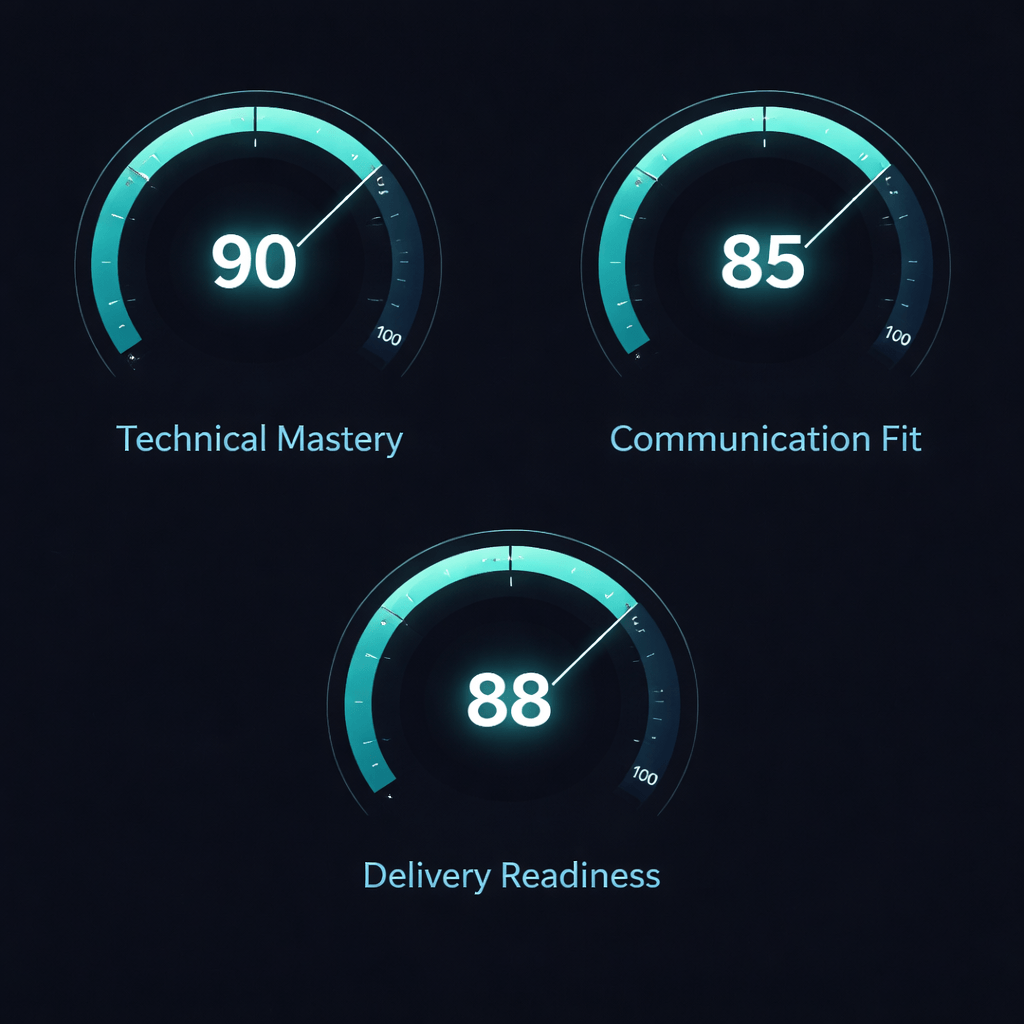
We built the Neural Index to change that. Every engineer placed through EliteSquad.ai is assessed across three dimensions before they reach a shortlist: Technical Mastery, Communication Fit, and Delivery Readiness. Each dimension is scored from 0 to 100. Only engineers who score 80 or above across all three dimensions are Neural-Certified and eligible for client shortlists.
What makes the Neural Index different is what Communication Fit and Delivery Readiness actually measure: async work hygiene, stakeholder management capability, time-zone compatibility, SLA track record, documentation quality, and ramp history. These are the signals that predict whether an engineer will deliver well on a real programme — not whether they passed an exam.
Every Neural Index report includes a recommended ramp plan: what needs to be in place in weeks one and two, what the engineer should be delivering independently by weeks three and four, and what full ownership looks like from week five onward. It is not a CV. It is a delivery forecast.
→
See a sample Neural Index report
We believe speed and quality are not a trade-off.
A common assumption in the delivery industry is that you can have quality or speed, but not both. Either you take the time to find the right person — which takes months — or you move quickly and accept more risk.
We reject that assumption. We built EliteSquad.ai’s bench and vetting model specifically so that speed and quality could coexist. Our shortlist time is 72 to 96 hours. Our average onboarding time is 14 days or less. The engineers in that shortlist are not speed-compromised — they are Neural-Certified against the same standard regardless of how urgently the partner needs them.
This is only possible because vetting happens before the request, not in response to it. The Neural Fleet — our pre-configured squad model across Cloud, Data, AI, DevOps, Analytics, and Managed IT — is built and maintained continuously, not assembled on demand.
72–96h
Shortlist time
From first request
Onboarding time
Engineer contributing
Neural Index threshold
All three dimensions
Client retention
Partners stay
What We Are Not — and Why That Matters
The technology delivery market has a lot of vendors who describe themselves in the same language. Pre-vetted. Fast. Quality-focused. Trusted partner.
We want to be specific about what EliteSquad.ai is not — because the differences are important.
We are not a recruitment agency.
A recruitment agency’s job ends at placement. Ours begins there. We are not paid to find someone. We are accountable for how the programme performs. That is a fundamentally different commercial and operational model.
We are not a staff augmentation platform.
Staff augmentation platforms provide bodies. We provide structured delivery — squads with defined ratios, a Delivery Manager, SLA commitments, weekly reporting, and a ramp plan. The engineer is not dropped into a technology firm’s process and left to figure it out. They arrive with a structure around them.
We are not a vendor who will go direct.
Some delivery partners operate in a grey area around client relationships. We do not. Our non-circumvention commitment is contractual, not reputational. Technology firms who work with us do so knowing their client relationships are protected by the agreement, not just by our word.
We are a delivery backbone. The technology firm is the face. We make them look good — and we stay invisible to the client unless the firm wants us visible.
Want to see how the model works in practice?
Read our success stories — real programmes, real outcomes.
What We Are Building — and Why the Timing Matters
We launched EliteSquad.ai at a specific moment in the technology services industry. That timing is not coincidental.
The MSP and technology services market is consolidating. Larger platforms are acquiring smaller firms. Vendor programmes are rewarding delivery performance over transactional resale. Buyers are demanding outcomes, not just resource hours. And the talent gap that has been quietly widening for years is now a structural constraint — one that is not going to close through traditional hiring alone.
In that environment, we believe the technology firms who will grow fastest are not the ones who hire more internal staff. They are the ones who build delivery models that can scale with their pipeline — reliably, quickly, and without putting client relationships at risk every time a new programme starts.
That is what EliteSquad.ai is built to enable.
The Neural Fleet — squads as a product, not a procurement exercise.
We have configured our delivery capacity as pre-built squads — Cloud, Data, AI, DevOps, Analytics, and Managed IT — each with defined role ratios and a Delivery Manager, ready to be deployed rather than assembled from scratch. This is the Neural Fleet. It exists so that technology firms can scale delivery like they scale software: predictably, with known inputs and known outputs, across US, EU, and APAC time zones.
→
Explore our full technology stack and squad configurations
The Neural Alliance — a partner programme that grows with you.
Technology firms who build their delivery model around EliteSquad.ai should benefit commercially from doing so. The Neural Alliance is our structured partner programme — three tiers with increasing benefits, priority access, cashback in Partner Points, dedicated support, and at the Apex tier, a Shadow CTO who can participate in pre-sales conversations and architecture reviews alongside the technology firm’s own team.
This is not a loyalty scheme. It is a commercial structure designed so that the firms who commit to the relationship get more from it over time — and so that the relationship deepens in both directions.
→
Explore the Neural Alliance partner programme
Trust as infrastructure.
We built a Trust Centre because we believe that the commitments a delivery partner makes should be documented, auditable, and contractually enforceable — not just stated on a website. Our Trust Centre documents everything: the non-circumvention guarantee, the delivery transparency framework, our security and compliance posture (GDPR, HIPAA, SOC 2 Type II, ISO 27001), our incident response protocols, and our performance monitoring approach.
We did this because the technology firms we work with are trusting us with something they built over years. We take that seriously enough to put it in writing.
→
Read the full Trust Centre
The Kind of Company We Are Trying to Be
Every company says they care about quality, speed, and trust. We are not going to claim that EliteSquad.ai is unique in caring about those things.
What we will say is this: the decisions we have made that cost us money are the most honest signal of what we actually believe.
- We turned down direct client work because we believe in the partner-only model — even when the direct opportunity was commercially attractive.
- We built the Neural Index before it was commercially necessary because we believed that the industry’s vetting standards were not good enough — even though the extra investment made us slower to launch.
- We built the Trust Centre and the contractual non-circumvention framework before any partner asked for it — because we believed that trust needs to be documented, not assumed.
These are not marketing decisions. They are operational ones. They shape every engagement we take, every engineer we place, and every relationship we build.
The technology services market does not need another vendor who says the right things. It needs delivery partners who behave differently — consistently, at scale, in the details that clients never see but always feel.
That is what we are trying to be.
The best technology firms in the world should be able to grow their practice without worrying that their delivery partner is a risk to their client relationships. Building that certainty — for every partner, on every programme — is the work we are here to do.
Frequently Asked Questions
If Any of This Resonates
We are not for every technology firm. We are for the ones who have felt the cost of a delivery partner letting them down — and who want a model that is structurally different, not just differently marketed.
If that is you, we would like to have a conversation. Not a pitch. A conversation about your delivery model, where the friction is, and whether EliteSquad.ai is the right fit.
Book a Discovery Call
No forms. No pitch deck. Just a straight conversation. We come back within 24 hours.