Why "We Have an In-House Team" Is the Most Expensive Sentence in Enterprise Tech Delivery (2026)
Who this article is for
01 The Case Study — Before the Argument
A US-based technology partner had already made the hire. The Power BI developer was onboarded, scoped, and sitting inside their delivery pipeline. On paper, the project was moving. In reality, it had stopped.
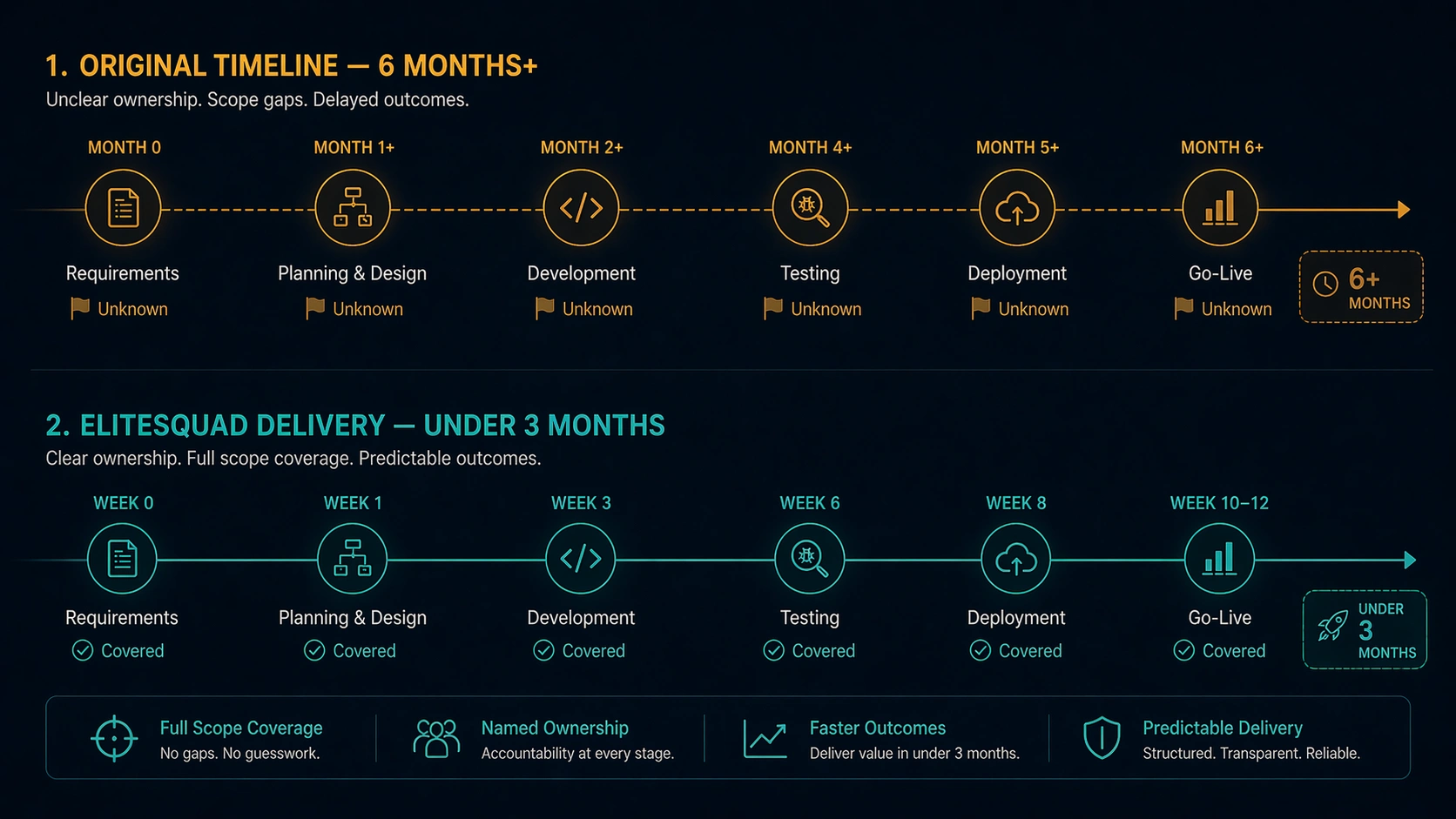
The project was projected to run six months or more, with significant unknowns logged at every sprint review. The partner brought in EliteSquad. The team assessed the full scope, mapped the gaps, and delivered against every requirement — ETL, performance optimisation, Power Automate, and reporting layer — in under three months.
Not because the original developer was wrong. Because the scope was never matched to a team that could see the whole system.
EARLY CTA — EDUCATION ANGLE
02 What "Scope Blindness" Is and Why It Happens
Scope Blindness is what happens when the person on the engagement can see their layer of the problem clearly — but cannot see, or was never asked to address, the layers around it. It is not incompetence. It is structural. And it is the defining failure mode of outsourced tech delivery accountability in 2026.
- Sprint reviews that show green on the dashboard layer and red everywhere else.
- Technical debt accumulating in the ETL pipeline because no one was scoped to address it.
- Stakeholder alignment meetings that multiply because outputs do not connect to each other.
- A timeline that stretches every two weeks because the unknowns are structural, not incidental.
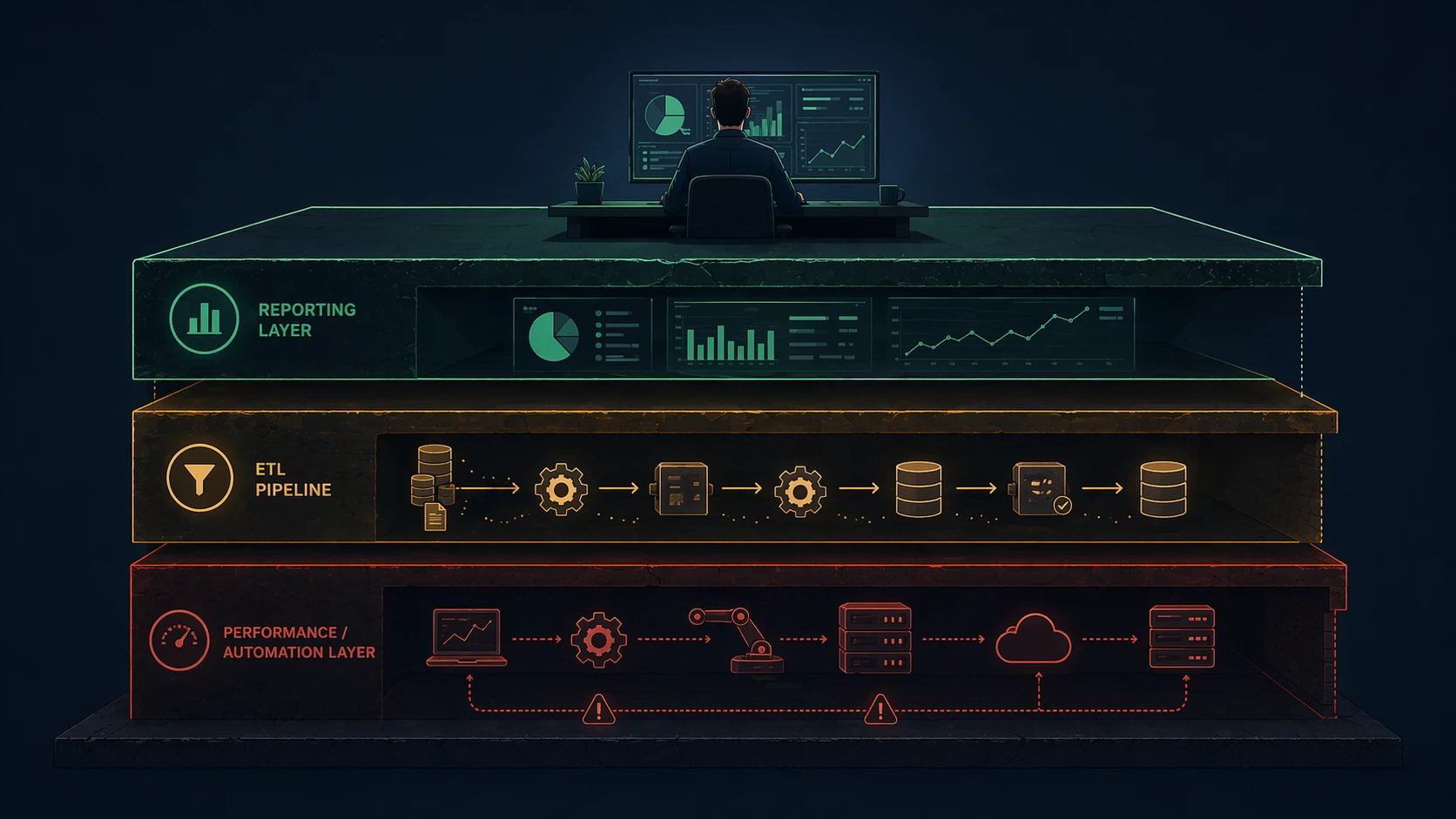
The US-based technology partner in the case study above had not made a hiring mistake. They had made a scoping mistake — and in scope blindness technology projects, that distinction matters enormously. It is a more common error, and a more expensive one.
03 Your In-House Team Is the Core — Not the Ceiling
- Niche skill for a defined engagement. A project requires a Databricks performance specialist for eight weeks. Hiring permanently does not make commercial sense. The skill gap creates drag until it is filled — and filling it through standard recruitment takes longer than the window the project can absorb.
- Short-term need where full-time hiring is commercially wrong. A partner wins a cloud migration engagement with a nine-month runway. A full-time hire creates overhead — recruiting time, onboarding cost, severance risk — that erodes the margin the engagement was supposed to generate.
- Team at capacity, delivery velocity dropping. The in-house team is good. They are also at 110% utilisation. Strategic work is being deferred. Technical debt is accumulating. The cost of this is invisible on a sprint board — but it compounds.
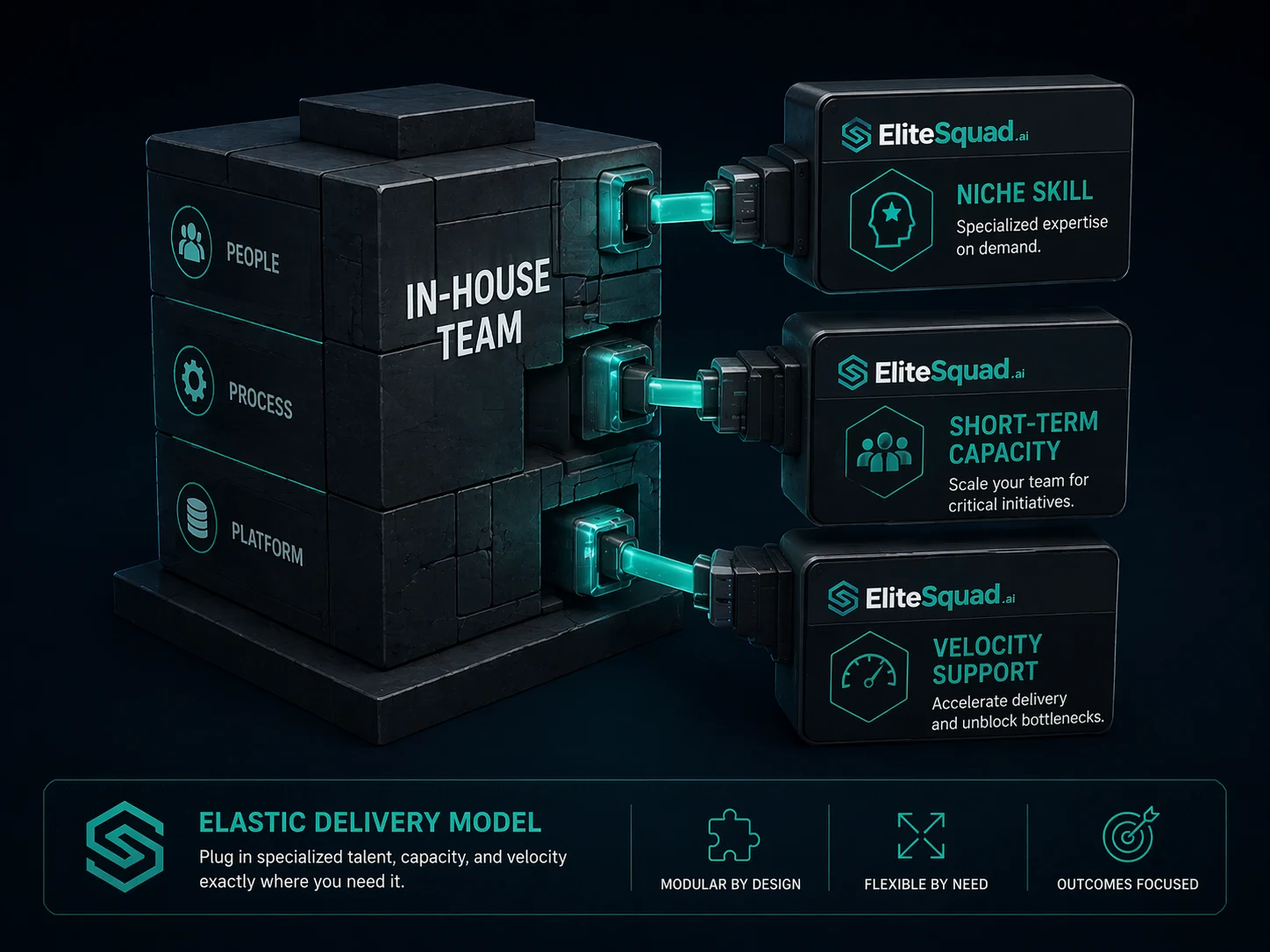
EliteSquad operates as a plugin into existing delivery structures. Partners joining the Neural Alliance partner programme get structured onboarding, quarterly reviews, and cashback on delivery volume. The engagement is scoped, the team is matched to the specific requirement, and a named Delivery Manager owns accountability end-to-end. The in-house team does not lose control. They gain capacity where the scope demands it.
04 The Invisible Cost of 'We're Fine' in 2026
- What work is not getting done because the team is at capacity?
- Which technical decisions are being made under time pressure that will need to be revisited?
- Where are the scope gaps — the layers of the system that are adjacent to the active work but outside the skill set of the team assigned?
— Pattern observed across EliteSquad partner engagements, 2024–2026
05 Why This Is Not Staff Augmentation — And Why That Matters
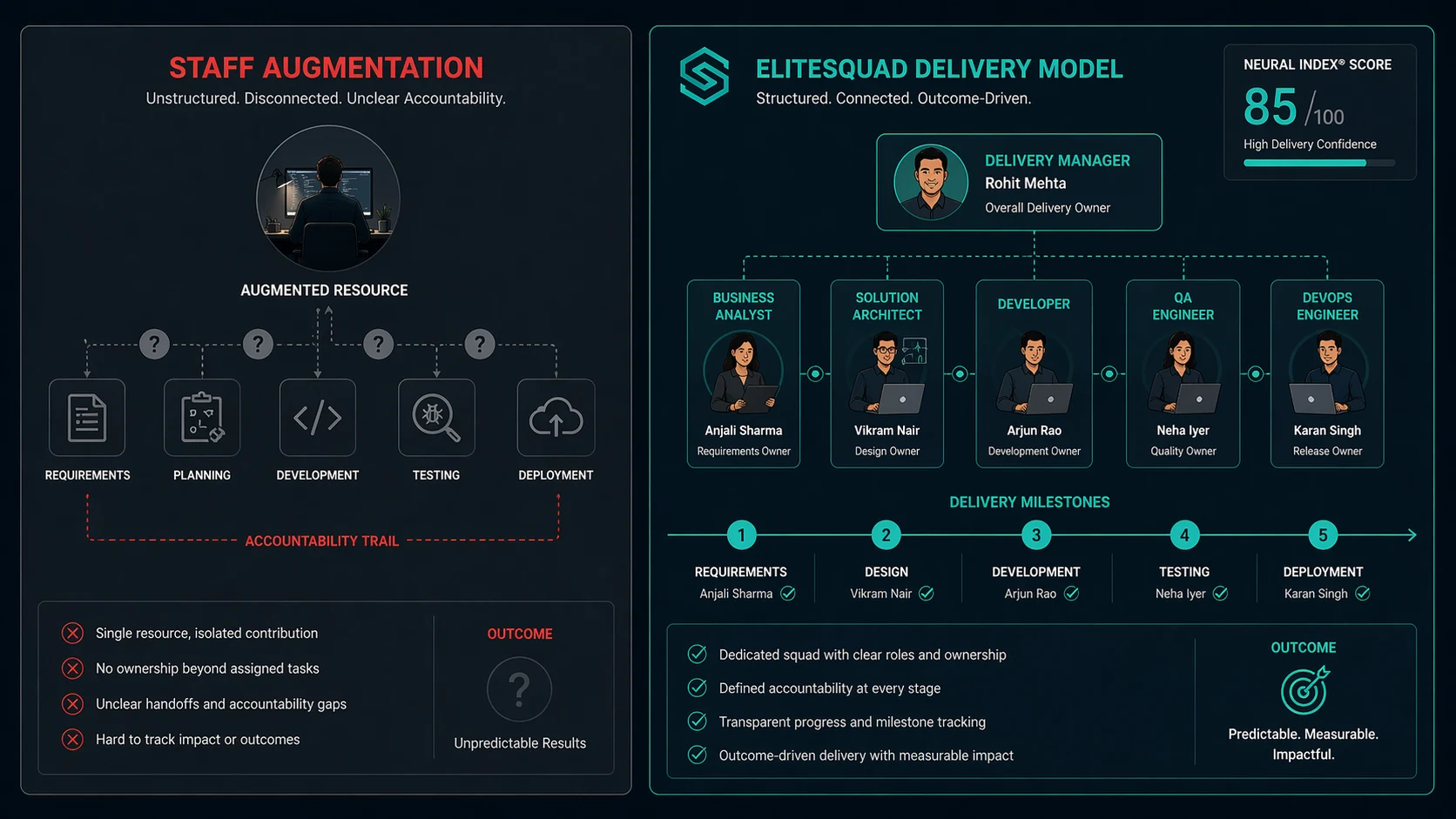
This is the scar tissue behind the ‘we have an in-house team’ objection. Most partners who say it have experienced staff augmentation at its worst — a body without a brief, accountability without structure, and a timeline that drifted because no one owned the outcome. The staff augmentation vs delivery partner distinction is not semantic — it is the difference between a vendor relationship and a delivery relationship.
EliteSquad is structured differently at a foundational level. Every engagement is delivery-owned, not resource-rented.
📋 Neural Index Certification — Minimum 80 across all three dimensions
The minimum threshold across all three is 80. The score is not a proxy for a CV — it is a structured assessment of whether a specific engineer can deliver in a specific type of engagement. Read how the Neural Index scoring system works and what an 80+ score means for your engagement.
06 What Elastic Delivery Looks Like in Practice in 2026
Modern enterprise technology projects — cloud migrations, data platform builds, AI and MLOps deployments — rarely fit inside a single skill set. They span cloud infrastructure delivery, data engineering, analytics, automation, and governance. Each of these requires deep data engineering delivery capability, not just surface-level tooling knowledge. A partner who wins one of these engagements needs access to a team that can see all of those layers simultaneously.
For the US-based technology partner in this article, the outcome was a project delivered in under three months against a six-month baseline — not because the EliteSquad team worked faster, but because they were scoped correctly from day one. See delivery outcomes across industries on the EliteSquad success stories page.
MID CTA — DIAGNOSTIC ANGLE
Frequently Asked Questions
What is the difference between staff augmentation and elastic delivery?
Staff augmentation places a resource inside your team and ends its accountability at placement. Elastic delivery is outcome-focused: a named Delivery Manager owns the engagement, engineers are scoped to the specific requirement, and governance is structured across the full delivery lifecycle. The accountability gap that defines bad augmentation experiences is addressed structurally, not contractually. For full governance documentation, visit the EliteSquad Trust Centre.
Does bringing in EliteSquad mean my in-house team loses control of the project?
How quickly can EliteSquad provide a shortlist for a specific engagement?
What is the Neural Index and why does it matter for delivery quality?
Does EliteSquad work with MSPs who already have delivery frameworks in place?
Yes — and this is the most common partner profile. EliteSquad integrates with existing delivery frameworks, not replaces them. The Neural Alliance partner programme is built around this model, with structured onboarding, quarterly reviews, and a clear accountability framework that complements existing partner operations.